What is DTF printing?
Direct-to-Film (DTF) printing is one of the most versatile ways to put a design onto fabric. The short version: your artwork is printed onto a transfer film, coated with adhesive powder, cured with heat, then pressed onto the garment. The result is a print that's vibrant, durable, and works on virtually any fabric — cotton, polyester, nylon, blends, light or dark.
Unlike screen printing (which needs separate screens for every color) or DTG (Direct-to-Garment) printing (which struggles on dark or synthetic fabrics), DTF lays down full-color, photorealistic designs in a single pass — no setup fees, no minimums, no fabric restrictions.
In 2026, DTF has become the default method for creators who need flexibility: any design, any garment, one unit at a time. It's the technology that makes print on demand actually work for the way modern creators sell — small batches, full color, all fabrics, ready to ship.
- Works on any fabric — cotton, polyester, blends, nylon, even hard-to-print synthetics. No fabric restrictions.
- Vibrant on dark colors — a white underlayer is laid down automatically, so prints pop on black, navy, and any dark garment.
- No minimums, no setup — print one unit profitably. No screens, no color separations, no MOQs.
- Lasts 50+ washes when cared for properly — stretch-resistant and crack-resistant.
- The sweet spot for creators — faster per-order than embroidery, cheaper than screen printing for small runs.
How DTF printing works: step by step
DTF condenses what used to be a multi-step transfer process into four simple stages. Here's what happens after you upload your design.
Step 1: Design to film
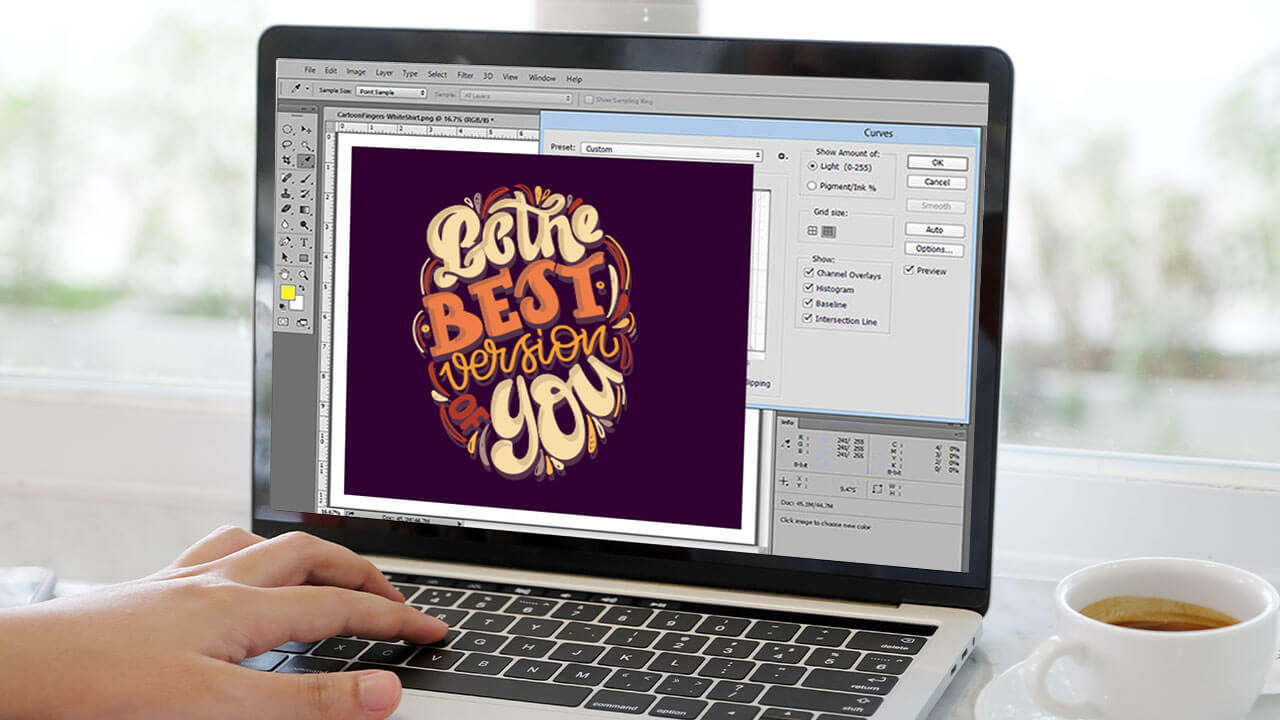
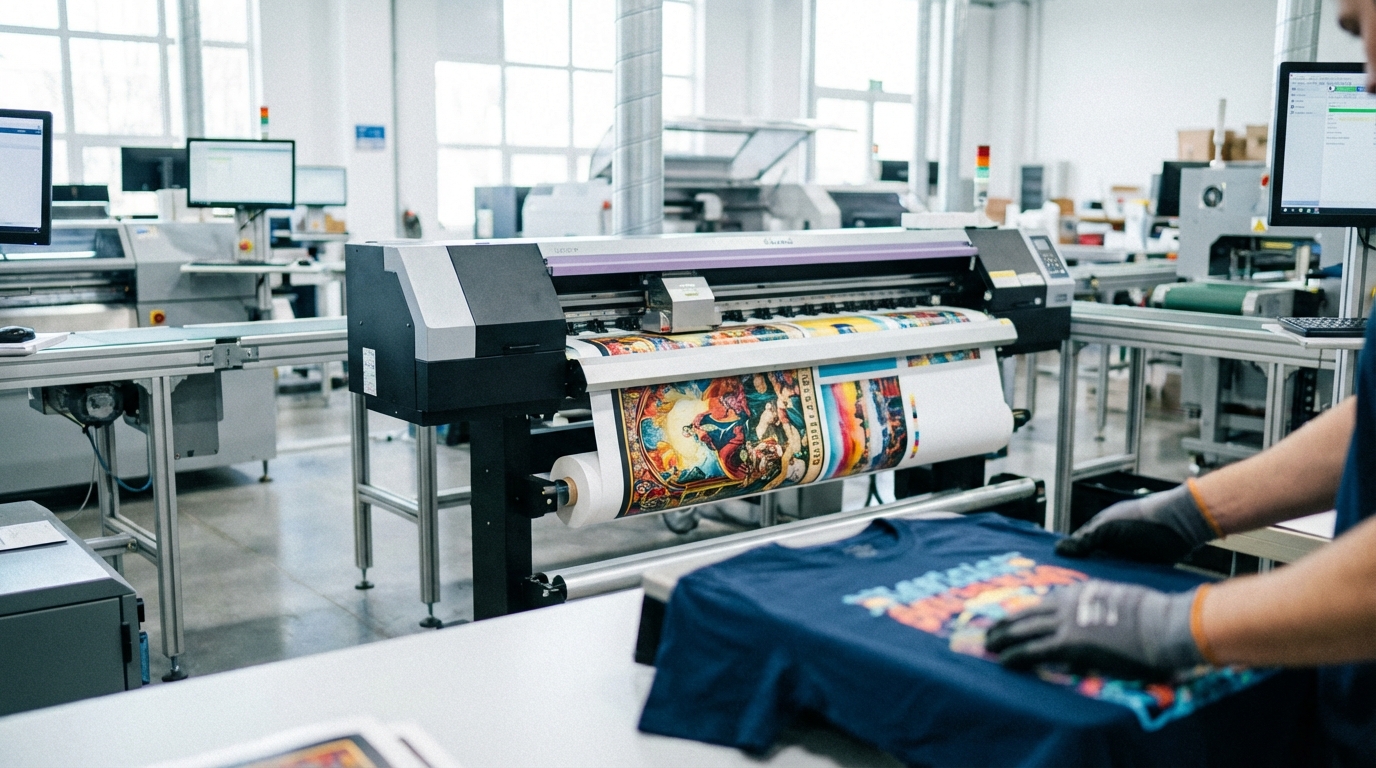
Your artwork is printed onto a clear PET (polyethylene terephthalate) film using water-based ink: the standard CMYK colors, plus a crucial fifth — white. The white ink lays down underneath your design, creating an opaque layer that makes colors pop on dark fabric.
Step 2: Adhesive powder
While the ink is still wet, a fine, heat-activated polymer adhesive powder is sprinkled across the design. Excess powder is shaken off, leaving a thin adhesive layer bonded only to the printed areas.
Step 3: Curing
The film passes through a heat-cure tunnel at around 160–170°C for 2–3 minutes. The adhesive melts and bonds permanently to the ink, creating a flexible, fabric-ready transfer.
Step 4: Heat press to garment
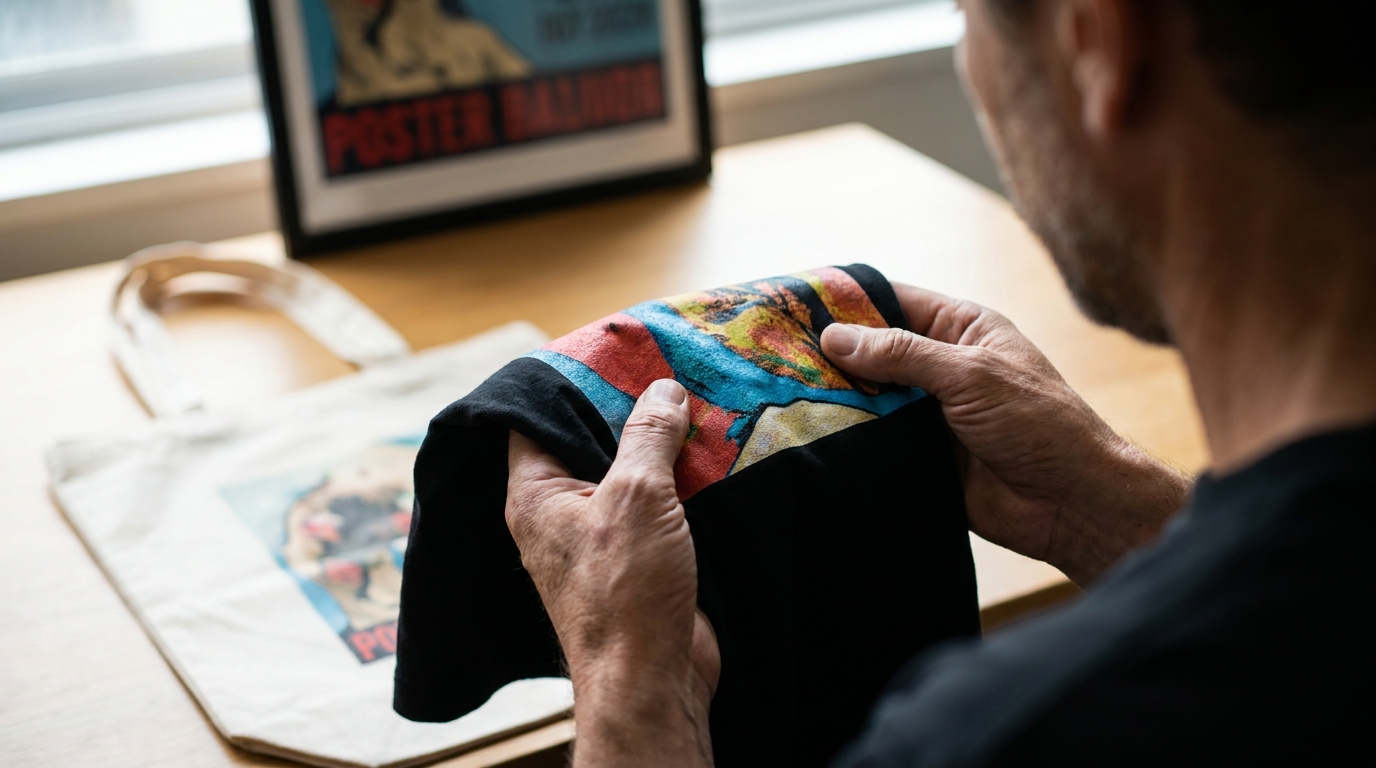
The cured film is positioned on the garment and pressed at around 160°C for 12–15 seconds. After pressing, the film backing is peeled away, leaving the design fused into the fabric fibers.
The result: a stretchy, soft-hand print that bonds to the garment without sitting on top of it. No screens, no plates, no setup — just digital file to wearable product in under five minutes per piece.
DTF vs DTG: how Gelato's two print methods compare
DTF and DTG are the two digital print technologies that power modern print on demand. Gelato's entire network is built on them — between them, they cover every fabric, every color, and every quantity creators need. Here's how they compare.
DTF (Direct-to-Film) — Gelato's primary method for full-color apparel
Best for: bold, full-color designs on any fabric, including dark and synthetic
Fabric range: cotton, polyester, blends, nylon, performance fabrics
Minimum order: one unit
Wash durability: 50+ washes
DTG (Direct-to-Garment) — Gelato's method for soft-hand prints on cotton
Best for: photorealistic prints on light cotton
Fabric range: cotton only (struggles on synthetics)
Minimum order: one unit
Wash durability: 40+ washes
Where screen printing fits
Screen printing is the traditional method built for batch manufacturing — high volumes of identical products with limited colors. It still has its place in factory-scale industrial print, but it doesn't fit how modern creators sell: one design at a time, full color, on whatever fabric the product calls for. DTF and DTG cover that entirely — which is why they're the technologies powering on-demand at scale.
Want a head-to-head on the two methods Gelato uses? Read our DTF vs DTG printing comparison.
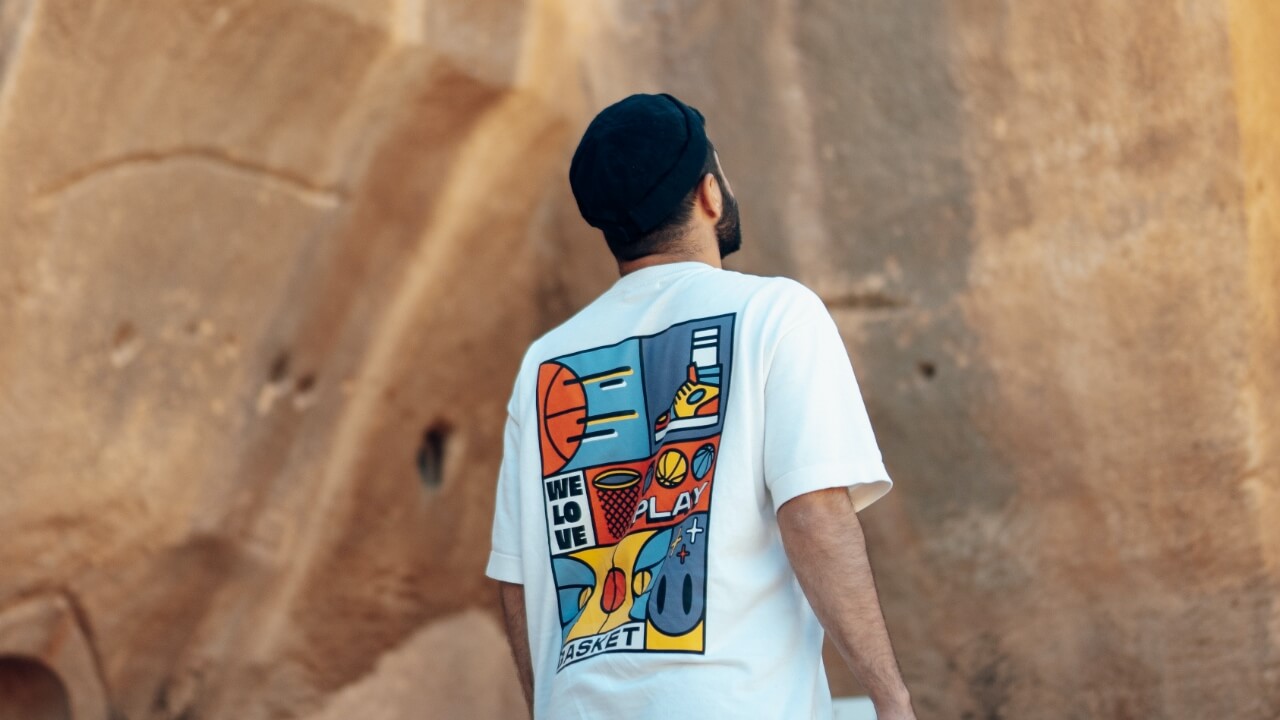
DTF on custom t-shirts
Premium t-shirts printed with DTF — vibrant on dark fabrics, 50+ wash durability, ready in minutes. Start at one unit, produced locally across 32 countries. No inventory, no risk.
Design a DTF t-shirt →When DTF is the right print method
DTF is the technology Gelato reaches for in five common scenarios.
1. Dark or colored garments with full-color designs
Black, navy, charcoal hoodies with photographic prints? DTF. The white underlayer means your design looks just as vibrant on black as on white.
2. Polyester, nylon, or performance fabrics
Sports jerseys, activewear, lined jackets — DTG can't reliably print these. DTF transfers fuse to synthetic fibers with the same durability as natural ones. If you're building a print-on-demand sportswear line, DTF is the technology behind it.
3. Bold graphic designs with multiple colors
DTF prints unlimited colors in a single pass. Designs that would have required four-color screen separations in the traditional industry print as one file with DTF.
4. Small batches (1–50 units)
No screens to make, no setup time. The marginal cost per print is the same whether you order one piece or 100.
5. Designs with fine detail or gradients
DTF handles photographic gradients, thin linework, and tiny text beautifully — and matches DTG for detail on cotton.
If your design hits two or more of these scenarios, you'll see exactly why Gelato standardizes on DTF for full-color apparel — it's the technology that fits the widest range of creator needs.
Five design tips for the best DTF results
When you upload a design to Gelato, our DTF setup handles the technical bits — ink mix, white underlayer, curing, pressing, fabric matching — automatically. The quality of the final print still depends on your design file. Here's how to give it the best chance.
1. Upload at 300 DPI minimum
DTF reproduces whatever you give it, including blurry edges and pixelation. Higher-resolution files mean sharper, more vibrant prints. PNG or high-quality JPEG, 300 DPI or better.
2. Use transparent backgrounds
A PNG with a transparent background lets the DTF process apply the white underlayer only where you want color. JPEGs with white backgrounds can leave faint outlines on dark fabrics.
3. Watch for see-through areas in your artwork
If your design has semi-transparent or low-opacity sections, the white underlayer may show through as a visible outline. Designs with clean, defined edges and full opacity reproduce best.
4. Preview before you publish
Gelato's mockup generator shows your design at scale on the actual garment, with the DTF white underlayer applied. Catching a sizing or contrast issue here is much cheaper than catching it after the first 50 orders ship.
5. Set wash care expectations with your customers
DTF prints last 50+ wash cycles when cared for properly. Include a simple care card with each order: cold wash, inside-out, no fabric softener, hang or tumble dry on low. Happy customers, lasting prints, fewer support tickets.
Pro tip: you can update a published product's design at any time. No inventory to write off, no risk in iterating — so test, learn, and refine until you find what sells.
Ready to print your first DTF design?
Upload your artwork, choose your garment, and we'll print and ship locally — no inventory, no setup fees, ready in days.
DTF printing FAQ
The bottom line
DTF printing has done for custom apparel what production on demand did for ecommerce: removed the barriers that made small-scale, full-color, any-fabric printing economically painful. If you're selling custom t-shirts, hoodies, sweatshirts, or any apparel — particularly in color-rich designs on dark garments — DTF is almost certainly the right choice.
The technology isn't a gimmick or a downgrade from DTG. It's an upgrade: more versatile, more durable, and more cost-effective for the order sizes most modern creators are actually producing.
At Gelato, every product in our apparel range is available with DTF printing, including premium options on Bella + Canvas, Gildan, Champion, and Stanley/Stella blanks. We print and ship through 140+ print partners across 32 countries — produce locally, sell globally, with no inventory and no risk. Print one. Print a thousand. Same quality, same speed.
Ready for the next step? Read our practical guide on how to launch a profitable print-on-demand t-shirts business.