GelatoConnect | Insights | Thought Leadership
Production on demand software: how local fulfilment at the unit of one is powering the creator economy
In a world of fractured supply chains and rising trade barriers, production on demand software is enabling print service providers to serve creators locally, personally, and at scale — down to a single unit.

Henrik Müller-Hansen
CEO & Co-founder, Gelato · April 2026
The supply chain era that just ended
For thirty years, global commerce ran on a simple principle: make it cheaply in one place, ship it everywhere. Brands optimised for cost. Logistics became an afterthought. The system worked — until it didn’t.
Conflict in the Middle East has disrupted critical shipping corridors. Sanctions and counter-sanctions are redrawing trade maps. Tariff volatility has reached levels not seen in a generation — with recent analysis showing that 82% of companies report new tariffs have impacted 20–40% of their supply chain activity. And extreme climate events are taking out infrastructure that no one planned to replace.
$184B
Annual cost of supply chain disruption globally (Source: Interos Annual Global Supply Chain Report) (Source: Interos Annual Global Supply Chain Report)
96%
Of major container ports experiencing disruption 300% above pre-2020 levels (Source: S&P Global Market Intelligence) (Source: S&P Global Market Intelligence)
40%
Reduction in disruption recovery time for companies adopting nearshoring
The old playbook — optimise for efficiency, accept the fragility — is finished. The new imperative is resilience. And resilience, in 2026, means producing close to where customers live.
Why localisation has become a business necessity, not a brand choice
Harvard Business Review’s January 2026 analysis, written by Accenture’s global strategy leadership, puts it plainly: for decades, multinationals treated localisation as a surface-layer adjustment — tweaking marketing or packaging to suit regional tastes. That approach is no longer sufficient. Trade policies conflict. Data laws clash. Governments are enforcing mandates for local sourcing and technology transfer. The result is a structural shift: companies duplicating supply chains, integrating regional suppliers, and accepting some loss of scale efficiency in exchange for resilience and market relevance.
This is not a trend confined to large multinationals. It is reshaping e-commerce at every level.
“In 2026, localising production is no longer a niche strategy — it has become the admission price to remain competitive, ensuring businesses can serve customers reliably regardless of global instability.”
Consumer behaviour is reinforcing this shift from the demand side. A 2025 Shopify report found that 57% of American shoppers are willing to pay more to support local businesses. In Canada, nearly eight in ten shoppers say supporting local businesses feels more important now than in previous years. This is not sentiment. It is purchasing behaviour, driven by a world that feels increasingly unstable.
The creator economy needs production at the unit of one
The creator economy has outgrown every early prediction. Millions of independent designers, artists, community builders, and entrepreneurs are now generating real revenue from physical products through e-commerce integrations through e-commerce integrations — not as side projects, but as primary businesses. These creators don’t think in pallets and minimum order quantities. They think in one. One hoodie. One wall print. One personalised notebook. For one specific customer, in one specific city.
The structural challenge has always been the same: how do you produce at the unit of one, at a competitive price, anywhere in the world, without holding inventory?
Production on demand software answers that question. And the convergence of geopolitical instability and consumer demand for local, personalised products has made that answer more commercially relevant than at any previous point.
57%
Of US shoppers willing to pay more for locally produced goods (Source: Shopify Future of Commerce 2025) (Source: Shopify Future of Commerce 2025)
3–5 days
Lead time from local production vs 6–8 weeks from overseas
70+
Countries where Gelato’s production network operates locally
What production on demand software actually does
Production on demand (POD) software connects the demand for personalised physical products with a distributed network of local manufacturers — automatically, at scale, and without the creator needing to manage a single production relationship.
When a customer orders a personalised product from a creator’s store, production on demand software routes that order to the nearest qualified production partner in the network. The software handles workflow automation, file management, quality parameters, pricing, and fulfilment tracking. The product is made locally and shipped a short distance. The creator never touches inventory. The customer receives a locally produced item, faster, with a lower carbon footprint, at a competitive price.
Order placed
Step 1
Customer orders from creator’s store
Smart routing
Step 2
POD software routes to nearest local producer
Local production
Step 3
Product manufactured locally by qualified PSP
Fast delivery
Step 4
Shipped a short distance to the customer
This is not a workaround. It is the architecture that makes local production economically viable at the unit of one — something that was structurally impossible before software-enabled distributed manufacturing.
GelatoConnect: production on demand software built for print service providers
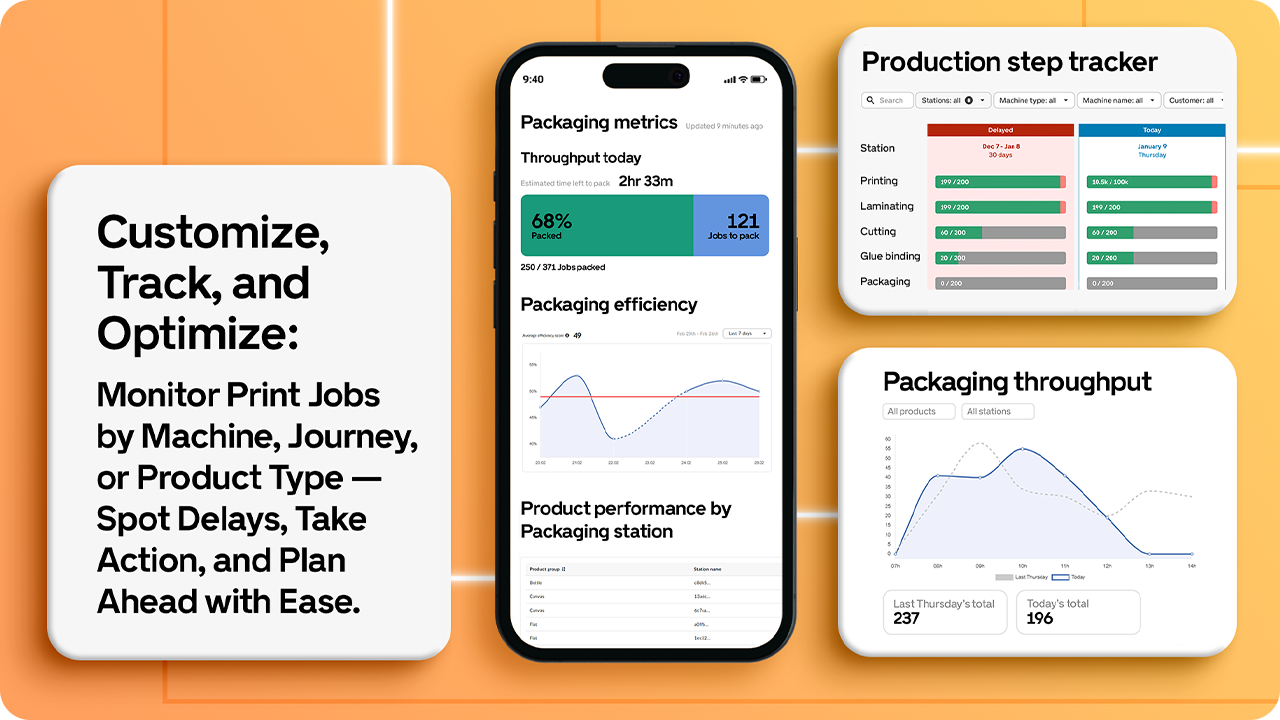
GelatoConnect is the production on demand platform built specifically for print service providers (PSPs). It is the software layer that connects PSPs — skilled local manufacturers already embedded in their markets — to the global flow of creator economy demand.
PSPs in the GelatoConnect network serve as the local production infrastructure for creators, brands, and retailers worldwide. A creator in Berlin gets their order produced in Berlin. A customer in Toronto receives a product made in Toronto. No cross-continental shipping. No exposure to trade disruptions. No single point of failure.
For PSPs, GelatoConnect provides automated order management, AI-powered estimating, seamless integration with e-commerce platforms, and the pipeline of demand that turns existing production capacity into recurring, scalable revenue. The software handles the complexity. The PSP focuses on production.
GelatoConnect’s ideal customer is a PSP generating between €300,000 and €20 million in annual revenue, operating in North America, Europe, or Australia and New Zealand, currently managing production across multiple systems without unified production software. These are businesses with real capability and local market presence — what they lack is the software infrastructure to connect that capability to creator economy demand at scale.
See how GelatoConnect works for PSPs
Explore the platform built to connect your production capacity with creator economy demand.
Explore GelatoConnect →The symmetry at the heart of local production on demand
There is a symmetry in this model that is easy to overlook.
Millions of Creators
Need local production infrastructure but cannot afford to build it
POD Software
Connects creator demand with local production capacity
Thousands of PSPs
Have production capacity & local expertise but lack a reliable demand pipeline
Production on demand software closes that gap. It makes the creator’s economic model viable. It makes the PSP’s capacity productive. And it makes local, personalised fulfilment possible at a price point and speed that the market now demands.
The geopolitical fragmentation of 2026 — disruptive as it is — has accelerated exactly the conditions where this model doesn’t just make sense. It is becoming the only model that makes sense.
“Advances in automation and AI-driven workflows have made small-batch, on-demand manufacturing economically competitive with large-scale overseas production. The trade-off between personalisation and scale no longer exists.”
What this means for print service providers in 2026
If you run a PSP, the macro environment of 2026 is the strongest possible commercial argument for investing in production on demand software now.
The demand for locally produced, personalised physical products is growing. Consumer willingness to pay a premium for local goods is documented and rising. Brands and retailers are actively reshoring and regionalising supply chains. And the creator economy continues to generate new demand for exactly the products PSPs are equipped to produce.
The question is not whether local, on-demand production is the future of e-commerce fulfilment. That question is settled. The question is whether your business is equipped with the software to capture that demand at the speed, quality, and scale the market now requires.
Explore how GelatoConnect can connect your production to creator demand →
Frequently asked questions
What is production on demand software?
Production on demand software is a platform that automates the end-to-end workflow for manufacturing personalised physical products only when an order is placed — eliminating inventory risk. It connects a creator’s or retailer’s e-commerce store to a network of local production partners, routing each order automatically to the nearest qualified manufacturer. The product is produced and shipped locally, typically within 3–5 days.
What is GelatoConnect?
GelatoConnect is the leading production on demand software platform for print service providers. It connects PSPs to creator economy demand through automated order management, AI-powered estimating, and integrations with major e-commerce platforms. PSPs using GelatoConnect become local fulfilment nodes in Gelato’s global network, producing personalised products for creators and brands in over 70 countries.
How does local production benefit creators?
Local production gives creators faster delivery times (3–5 days vs 6–8 weeks), lower carbon emissions, no inventory risk, and a brand story that resonates with consumers who prefer locally made goods. It also insulates their business from global supply chain disruptions, tariff changes, and geopolitical volatility.
Why is local fulfilment more important in 2026?
Supply chain fragility has reached record levels. 96% of major container ports are experiencing disruptions 300% above pre-2020 levels. Tariff volatility, trade barriers, and geopolitical instability have made long, linear global supply chains too risky and too slow. At the same time, consumer demand for locally produced goods has increased significantly.
What types of print service providers does GelatoConnect serve?
GelatoConnect is built for PSPs generating between €300,000 and €20 million in annual revenue, operating across North America, Europe, Australia, and New Zealand. The platform is designed for PSPs currently managing production across multiple disconnected systems.
What is the creator economy and why does it need local production?
The creator economy refers to the ecosystem of independent creators — designers, artists, communities, and entrepreneurs — who build businesses selling products directly to their audiences. These businesses are characterised by high personalisation, low order volumes, and the need for fast, reliable fulfilment. Local production on demand is the only model that allows creators to offer personalised physical products without holding inventory.
About the author

Henrik Müller-Hansen
CEO & Co-founder, Gelato
CEO and co-founder of Gelato, the global production on demand platform. Gelato operates across three business units: GelatoConnect (B2B SaaS for print service providers), GelatoCreate (creator subscriptions), and Optimalprint (consumer e-commerce). The Gelato network spans 70+ countries and enables local production at the unit of one for creators, brands, and retailers worldwide.
Ready to connect your production to creator economy demand?
Join the GelatoConnect network and turn your local production capacity into scalable, recurring revenue.