T-Shirt Gang, a Canadian apparel fulfillment operation, cut shipping costs by up to 40 percent after consolidating carrier selection, label creation, and postage prepayment onto one platform. Across the GelatoConnect customer base, the average customer reduces print shipping costs by 10 to 25 percent. The top-20 customer cohort saw shipping cost per order drop from EUR 5.20 to EUR 4.00, a 23 percent reduction in a single P&L line item.
For an operations leader running carrier spend analysis at a mid-sized print service provider, the question is rarely whether to renegotiate the carrier contract. The question is how to bring shipping costs down without changing carriers, without disrupting customer SLAs, and without adding headcount. The answer is carrier orchestration, the discipline of running rate shopping, address validation, dimensional weight, packaging, and carrier mix on the same record as the production schedule.
This playbook lays out the five levers, the 30-day rollout, and where the savings cap.
Why print shops overspend on shipping
Most PSPs ship through a default carrier on a default service level. Rate cards live in a stand-alone shipping module that does not see the actual job specifications, the production date, or the customer SLA on the order. The rep who quotes the order does not see the per-job carrier cost. The packer who creates the label does not see the rate alternatives across regional carriers, consolidators, or last-mile partners. The CFO sees the aggregate carrier spend at month-end and asks why it is up 8 percent on flat order volume. Each step is internally consistent, and the gap between them is the overspend. Carrier orchestration closes that gap by making the rate decision visible at quote, at production, and at dispatch, on a single record.
Five carrier-orchestration levers that reduce print shipping costs by 20 to 40 percent
1. Rate shopping at order intake
Multi-carrier rate shopping compares every available carrier on price, ETA, and historical reliability before the label is generated, not after the package is on the dock. The rate that wins the shipment is the rate that fits the job specifications and the customer SLA, not the rate attached to a default service level.
For carrier rate shopping to work, every carrier needs to live in the same orchestration layer, on the same record as the job ticket. Carrier portals do not solve this. They require an operator to log in five times, copy package data into each interface, and choose by hand. A stand-alone shipping software covers part of it but does not see the production schedule, so the cost decision and the production decision stay disconnected.
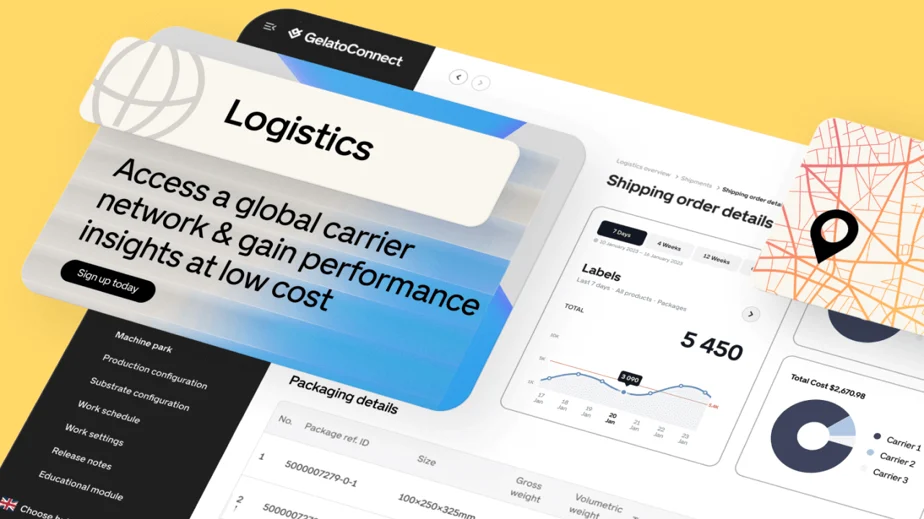
GelatoConnect compares rates and ETAs across 80+ integrated carriers, including national carriers, regional specialists, and last-mile partners, and selects the optimal carrier automatically at the moment of dispatch.
2. Address validation as a cost lever, not a quality check
Address validation usually gets filed under quality control. It is actually a direct cost lever. Every undeliverable shipment is a reprint cost, a reship cost, a customer service cost, and a missed SLA penalty. The carrier still bills for the original label.
ESP Colour, a UK commercial printer, ran the math on what bad addresses cost them. The number came back at 17 percent of total carrier spend tied to returns, relabeling, and delays caused by invalid addresses reaching the production floor. After address validation moved upstream of label generation, that line item collapsed.
The mechanics are simple. Validate the address at order intake, surface invalid or ambiguous addresses to a human reviewer before production starts, and never let a known-bad address generate a label. The cost gets removed before it appears on the invoice.
3. Dimensional weight optimization
National carriers price most domestic parcel shipments by dimensional weight rather than actual weight. A two-pound shirt in a too-large box bills at the rate of a five-pound parcel. The packaging decision drives the carrier rate as much as the carrier choice does, and most PSPs leave that decision at the packing station, where the operator picks the closest available box.
A unified platform ties the packaging spec to the carrier rate at quote time. The packing decision is made once, in the production setup, and applied automatically per SKU. Box size, fill, and void become rate variables instead of operator habits.
Dimensional weight stops being a surcharge that shows up on the invoice and starts being a cost the system controls before the parcel ships.
4. Volume aggregation across carrier partners
A mid-sized PSP shipping 500 to 5,000 parcels a week negotiates rates as a mid-sized PSP. The same parcels routed through a platform that aggregates volume across the customer base and across 80+ carrier partners get a different rate.
This is structural, not negotiated. The platform writes one volume agreement with each carrier, then makes that rate available to every PSP on the platform. The per-shipment rate available through aggregation is not the rate the same carrier would quote a single mid-sized PSP directly. GelatoConnect is also actively negotiating new carrier rates and adding new shipping methods on a continuous basis on behalf of every PSP using the platform.
Negotiating alone, with two or three direct carrier contracts, leaves the volume-discount layer on the table by structure, not by effort.
5. Native carrier integration replacing the manual rate-shopping desk
At a typical mid-sized PSP, manual rate comparison, label creation, postage prepayment, and carrier portal logins consume the equivalent of one full-time operations role. Someone logs into the carrier portal, copies package details, compares rates, picks a carrier, generates the label, prepays postage, and reconciles the carrier invoice at month-end. None of this work creates customer value. It exists because the rate-shopping desk has to live somewhere.
Native carrier integration runs the entire workflow inside the production platform, on the same record as the order. The desk goes away.
T-Shirt Gang eliminated this work end-to-end and cut shipping costs by up to 40 percent in the process. Manual rate negotiation, label creation, and postage prepayments were removed entirely from the operations workflow. The Canadian apparel fulfillment operation now runs carrier selection without a rate-shopping desk.
The 30-day carrier-cost rollout playbook
- Days 1 to 7: baseline current carrier spend. Pull the last 90 days of shipments. Group by carrier, service level, and weight band. Calculate the actual cost per shipment versus the quoted rate at quote time. The gap is the overspend rate, and the size of that gap is the savings ceiling.
- Days 8 to 14: stand up carrier rate shopping at order intake. Connect every carrier into one orchestration layer. Run shadow quotes against the baseline shipments to identify the savings curve before flipping production traffic over.
- Days 15 to 21: turn on address validation at intake. Push the validation gate upstream of label generation. Track the percentage of shipments caught at intake versus the previous after-failure rate, and tag every save against the original carrier invoice.
- Days 22 to 30: validate against baseline. Compare cost per shipment, undeliverable rate, and labor hours on the rate-shopping desk against the day 1 to 7 numbers. Most mid-sized PSPs see 15 to 25 percent shipping cost reduction by day 30, and the path to 40 percent opens once dimensional-weight optimization and volume aggregation kick in.
The CFO line items
Carrier-orchestration savings show up on four separate P&L line items, not one. Lower per-shipment rate from rate shopping. Lower reprint and reship cost from address validation. Lower packaging spend from dimensional-weight optimization. Lower operations labor from the eliminated rate-shopping desk. Most CFOs only model the first line item, comparing the new average shipping rate against the old contract, and miss the other three. The four line items together are what take a project from a 5 to 8 percent savings story to a 20 to 40 percent savings story.
Where the savings cap
Carrier orchestration cannot fix freight-class issues, weight-restricted SKUs, hazmat shipments, or international customs disputes. The 20 to 40 percent savings range applies to the standard parcel volume that makes up the bulk of mid-sized PSP shipping spend. Specialty freight remains a manual workflow with carrier-specific paperwork, and the savings on that segment come from direct negotiation rather than orchestration. PSPs that try to apply the playbook to specialty freight will find diminishing returns. PSPs that apply it to standard parcel volume find the savings show up in 30 to 60 days.
Customer outcomes
T-Shirt Gang, the Canadian apparel fulfillment operation, cut shipping costs by up to 40 percent and eliminated manual rate comparison, label creation, and postage prepayments end-to-end.
ESP Colour saved 17 percent on carrier costs through address validation alone, on top of a 95 percent reduction in quoting time and a doubled profit margin from the broader GelatoConnect rollout.
Bennett Graphics took production waste from 41 percent to 10 percent, cut packaging and dispatch labor by 80 percent, and now runs a real-time KPI dashboard across the operation.
TidyMerch took procurement from two hours per day to under one minute and recovered 11 percent of volume previously lost to stockouts.
Different operations, same architecture. Each PSP moved the operational decision onto a single connected record, and the cost line items came down together.
The structural answer
To reduce print shipping costs in 2026 is not a carrier-negotiation problem. It is a carrier-orchestration architecture problem. PSPs that move carrier rate shopping, address validation, and label generation onto the same record as the production schedule cut shipping costs 20 to 40 percent without renegotiating a single rate card. PSPs that do not are paying a per-shipment overspend that scales linearly with order volume. The gap is structural, and it widens as the business grows.
Explore GelatoConnect
- GelatoConnect Logistics: AI carrier selection across 80+ partners with address validation at intake.
- GelatoConnect Workflow: the unified production layer that holds carrier, packaging, and dispatch on one record.
- GelatoConnect Strategy: the platform's pricing and growth model for finance and operations leaders.
- The supply chain visibility gap in print
- Why workflow software loses logistics visibility (and how to fix it)
- Print workflow automation: integrating procurement, scheduling, and shipping data
- The print CFO's TCO model for production software
- Protect your shipping margins in a volatile world (webinar)
- ROI report: GelatoConnect customer outcomes
- See GelatoConnect in action: walk through the platform live with our team.
Frequently asked questions
How much can print shops realistically reduce shipping costs by?
T-Shirt Gang cut shipping costs by up to 40 percent across its Canadian apparel fulfillment operation after consolidating carrier selection, label creation, and postage prepayment onto one platform. Across the GelatoConnect customer base, shipping costs come down 10 to 25 percent on average. The top-20 customer cohort saw shipping cost per order drop from EUR 5.20 to EUR 4.00, a 23 percent reduction in a single P&L line item. The 20 to 40 percent range applies to standard parcel volume, not specialty freight.
What is carrier orchestration for print shops?
Carrier orchestration is the discipline of running rate shopping, address validation, dimensional weight, packaging, and carrier mix on the same record as the production schedule. Rather than logging into carrier portals or routing every shipment through a default service level, the platform compares 80+ carrier partners on price, ETA, and historical reliability before label generation, and selects the optimal carrier automatically at dispatch.
Why does address validation reduce shipping costs?
Every undeliverable shipment is a reprint cost, a reship cost, a customer service cost, and a missed SLA penalty. The carrier still bills for the original label. ESP Colour saved 17 percent on carrier costs through address validation alone, by catching bad addresses at order intake rather than after a failed delivery. Address validation moves the cost out of the system before it appears.
What is dimensional weight, and how does it affect print shipping costs?
National carriers price most domestic parcel shipments by dimensional weight rather than actual weight. A two-pound shirt in a too-large box bills at the rate of a five-pound parcel. The packaging decision drives the carrier rate as much as the carrier choice does. A unified platform ties the packaging spec to the carrier rate at quote time, forcing the dimensional-weight decision out of the packing station and into the cost record.
How long does a carrier-cost rollout take?
30 days using the phased playbook. Days 1-7 baseline current carrier spend. Days 8-14 stand up rate shopping at order intake. Days 15-21 turn on address validation upstream of label generation. Days 22-30 validate against baseline. Most mid-sized PSPs see 15-25 percent shipping cost reduction by day 30, with the path to 40 percent opening once dimensional-weight optimization and volume aggregation kick in.
Where does carrier orchestration not work?
Carrier orchestration cannot fix freight-class issues, weight-restricted SKUs, hazmat shipments, or international customs disputes. The 20 to 40 percent savings range applies to standard parcel volume that makes up most mid-sized PSP shipping spend. Specialty freight remains a manual workflow and benefits from direct negotiation rather than orchestration.