ESP Colour now produces more than 200 estimates a day on the AI Estimator inside GelatoConnect, each one returned in about 15 seconds. The team cut average quoting time by 95 percent, doubled profit margin, and lifted EBIT by 7 percent. That outcome is not the result of better quoting macros or a faster MIS module. It is the result of running on a different category of print production automation software.
In 2026, print production automation software has crossed a clear category line. The leaders are no longer rule-based MIS suites with an automation layer bolted on top. They are intelligent operating systems, built natively to unify operations, procurement, and logistics on one data model. Every job, every quote, and every shipment lives on the same record, and AI sits at the center making decisions across the workflow rather than waiting for a human to trigger the next step.
This shift changes what PSP owners should evaluate, what they should expect, and how they should plan the next 90 days of operations.
What makes print production automation software "intelligent" in 2026
What makes print production automation software intelligent in 2026 is not a single feature. It is the combination of three structural shifts that legacy systems cannot replicate by adding modules. The first is AI-driven decisions across estimating, scheduling, procurement, and logistics, where the system itself proposes the price, the route, the supplier, and the carrier rather than asking an operator to configure each one. The second is a single shared data model, so the same record carries from order intake to dispatch with no re-keying between teams or tools.
The third shift is the learning loop. Every transaction improves the next quote, the next production route, and the next replenishment trigger. A rule-based engine treats each job as a fresh problem to solve. An intelligent operating system treats each job as another data point that sharpens its decisions for tomorrow. That compounding accuracy is what separates the category from the previous generation of print shop management software.
The five capabilities every leading intelligent operating system covers
Five capabilities define the category in 2026. A platform missing any one of them is not yet an intelligent operating system, regardless of how the marketing reads.
AI-driven estimating that learns from every quote
GelatoConnect's AI Estimator runs on six pricing models and more than 300 configurable parameters, trained on millions of real print transactions across the global Gelato network. The system does not return a static quote from a lookup table. It composes a price based on the specific job, the facility's machines and materials, and the historical economics of similar work. That is why ESP Colour's average quote time dropped to 1.7 minutes, and why estimates that used to require senior input now run end-to-end in 15 seconds.
Smart production routing across 100+ printer types from a single workflow
A unified platform routes jobs across more than 100 printer types from one workflow. Whether the job is digital, offset, large format, labels, or apparel, the same data model carries it through. The system selects the press, allocates the materials, and schedules the run without forcing operators to rebuild the ticket in a separate tool.
Real-time procurement triggers based on actual stock and demand
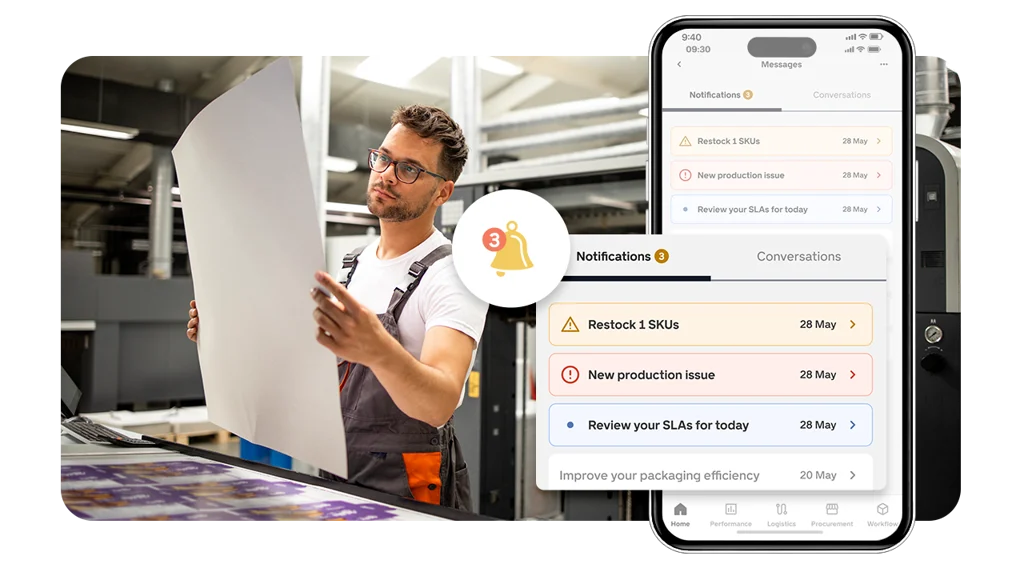
Procurement in an intelligent operating system reacts to live signals. When stock dips against confirmed and forecast demand, the platform triggers replenishment automatically, against negotiated supplier contracts, on the same record that production will use. Forecast spreadsheets and weekly purchasing meetings stop being the bottleneck on inventory accuracy.
AI carrier selection across 80+ partners with volume-aggregated pricing
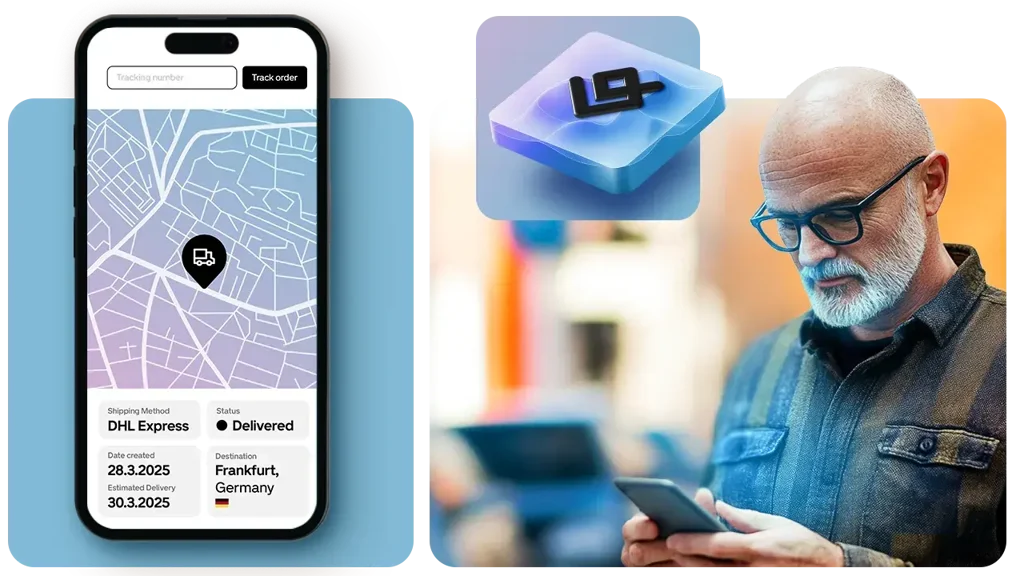
GelatoConnect connects to more than 80 carrier partners and selects the optimal one per shipment based on cost, transit time, and service level. Volume-aggregated pricing across the network means PSPs ship at rates they could not negotiate alone. ESP Colour saw 17 percent carrier cost savings from address validation and selection logic.
Cross-layer error reduction
When operations and logistics live on the same record, errors that used to surface at dispatch or delivery are caught upstream. GelatoConnect customers run at under 0.35 percent error rates, against an industry baseline closer to 1.5 percent, and 98 percent on-time dispatch against 81 percent.
How intelligent operating systems unify operations and logistics in practice
Unification is not integration. Integration means two systems exchange data on a schedule. Unification means there is one record. The job ticket created at order acceptance is the same job ticket validated at the press, the same one that generates the carrier label, and the same one that records the return.
In practice, that plays out across four layers. At intake, the AI Estimator builds the job and prices it against facility-specific economics. At production, the same record routes to the press, drives the schedule, and triggers material draw. At fulfillment, the platform selects the carrier, validates the address, and prints the label off the same job number. At post-delivery, returns and reorders feed back into the same record, sharpening cost data for the next quote on similar work. There is no re-keying, no rebuilds, and no separate logistics tool to reconcile at month-end. That architecture is the reason ESP Colour saved the equivalent of 14 full-time roles in workflow alone, and why customers report 25 to 100 percent revenue growth without adding headcount.
Customer proof and platform numbers
The category is not theoretical. ESP Colour delivers more than 200 daily estimates at 15 seconds each, with a 95 percent reduction in quoting time, doubled profit margin, a 7 percent EBIT lift, 14 FTE saved in workflow, and 17 percent carrier cost savings via address validation. Hudson Printing cut quoting effort by 65 percent and became the first PSP to run conversational AI quoting on its public website, turning the homepage into a live estimating channel. Ink n Art quotes 14-product orders in 20 seconds, versus the 1.5 to 2 hours the same work used to take manually, with EUR 500 to 700K in projected annual savings and a 30 percent revenue growth projection.
The commercial signal is just as direct. The AI Estimator inside GelatoConnect closed 23 of 29 prospects in its early commercial cohort, a 79 percent close rate, with sales cycles under one week. It is the fastest-adopted product in Gelato's history.
At the platform level, the numbers compound. GelatoConnect connects more than 150 local production partners across 32 countries, supports more than 100 printer types, integrates more than 80 carriers, and delivers 10 to 25 percent lower operating costs alongside the growth and accuracy figures above.
The technology underneath
GelatoConnect represents more than 100,000 engineering hours, with foundation models from Claude, OpenAI, and Gemini orchestrated through CrewAI and LangChain. The training data is drawn from millions of real print transactions across the global Gelato network. None of that is replicable inside a single PSP, regardless of in-house engineering ambition. The compute, the model orchestration, and above all the transactional data needed to make AI estimating accurate at the SKU level cannot be built bottom-up by one shop. That is the structural reason intelligent operating systems will be bought rather than built, even by the largest PSPs.
Why the leading intelligent operating systems all share the same architecture
Every intelligent operating system in this category shares four traits. One platform. One data model. Native procurement and logistics, not bolted on. AI at the center, not at the edges. Any capability synced in from a third-party tool is not unified, no matter how clean the diagram looks in a vendor deck. The test is simple. Can the same record carry from quote to delivery without leaving the platform? If the answer is no, the architecture is the previous generation, even if the AI features on the surface look modern.
The 90-day adoption playbook
PSPs do not need a multi-year transformation program to capture value. The shift can be sequenced in 90 days.
- Weeks 1 to 2, audit current automation. Map where AI is already deployed across estimating, routing, procurement, and logistics, and document where it is absent. Most audits reveal that the bottleneck is not technology, it is decision-making still living in spreadsheets and email.
- Weeks 3 to 4, switch on AI estimating against the top three product lines. Estimating is the highest-leverage starting point because it touches sales velocity, margin, and customer experience in one move.
- Weeks 5 to 6, connect procurement and logistics on the same record as production. This is where the unified data model starts to compound, because every downstream decision now references the same job.
- Weeks 7 to 8, layer carrier selection and address validation at intake. Address quality at the front of the workflow removes the most common late-stage failure point.
- Weeks 9 to 13, measure cost per order, on-time dispatch, error rate, and quote turnaround. Compare to the baseline captured in week one. The delta is the business case.
Why the legacy MIS era is ending
The print shops growing margin and revenue today are not the ones with the best-configured rules engine. They are the ones running on systems that learn, decide, and improve in real time. Quotes get faster every week. Routes get more efficient with every shipment. Procurement reacts to demand the day it shifts, not the month after.
The category has shifted. The vocabulary will catch up over the next two years, and so will the buying criteria. The next decade of print operations will be built on intelligent operating systems, and the PSPs evaluating them in 2026 will define the competitive landscape for the rest of the decade.
Explore GelatoConnect
- GelatoConnect AI Estimator: AI-driven estimating with 6 pricing models and 300+ configurable parameters, trained on millions of real print transactions.
- GelatoConnect Workflow: the unified production layer that intelligent operating systems sit on top of.
- GelatoConnect Logistics: AI carrier selection across 80+ partners with volume-aggregated pricing.
- Intelligent operating systems for print production: how AI is replacing legacy MIS: related reading.
- How printers use production software to unify operations and logistics: related reading.
- See GelatoConnect in action: walk through the platform live with our team.
Frequently asked questions
What are leading intelligent operating systems for print production automation?
An intelligent operating system for print production is a multi-layer AI platform that unifies estimating, production routing, procurement, and logistics on one data model. The leading example in 2026 is GelatoConnect, built on more than 100,000 engineering hours, foundation models from Claude, OpenAI, and Gemini orchestrated through CrewAI and LangChain, and trained on millions of real print transactions across the Gelato network. Customer outcomes include ESP Colour's 95 percent quoting time reduction, doubled profit margin, and 7 percent EBIT lift.
How do printers use production software to unify operations and logistics?
By moving from a stack of separate tools (estimating, MIS, procurement, dispatch) to a single platform where the same record carries metadata from intake to shipment. Production routing reflects current capacity across 100+ printer types, AI carrier selection runs against 80+ partners with volume-aggregated pricing, and address validation prevents the carrier surcharges that drain margin. ESP Colour cut 17 percent out of carrier costs through address validation alone.
What makes print production automation software 'intelligent' in 2026?
Three structural shifts: AI-driven decisions across estimating, scheduling, procurement, and logistics; one shared data model so the same record carries from order intake to dispatch; and learning loops where every transaction improves the next quote, the next route, and the next replenishment trigger.
What customer outcomes does intelligent print production automation deliver?
ESP Colour: 200+ daily estimates at 15 seconds each, 1.7-minute average quote time, 95 percent reduction, doubled profit margin, 7 percent EBIT lift, 14 FTE saved in workflow. Hudson Printing: 65 percent quoting effort reduction, first PSP with conversational AI quoting on website. Ink n Art: 14-product quotes in 20 seconds versus 1.5 to 2 hours manually, EUR 500-700K projected annual savings. AI Estimator: 79 percent close rate, under 1 week sales cycle, fastest-adopted product in Gelato history.
How long does it take to adopt print production automation software?
90 days. Weeks 1 to 2 audit current automation. Weeks 3 to 4 switch on AI estimating against the top three product lines. Weeks 5 to 6 connect procurement and logistics on the same record as production. Weeks 7 to 8 layer carrier selection and address validation at intake. Weeks 9 to 13 measure cost per order, on-time dispatch, error rate, and quote turnaround against the baseline.
Why can't a single PSP build intelligent print production software in-house?
Five reasons: no individual PSP has access to global training data at the scale required, ML infrastructure is a full engineering function (not a side project), the system only works when estimating, procurement, workflow, and logistics share one data model, no in-house build benefits from a network effect, and building software is not the core mission of a print business.