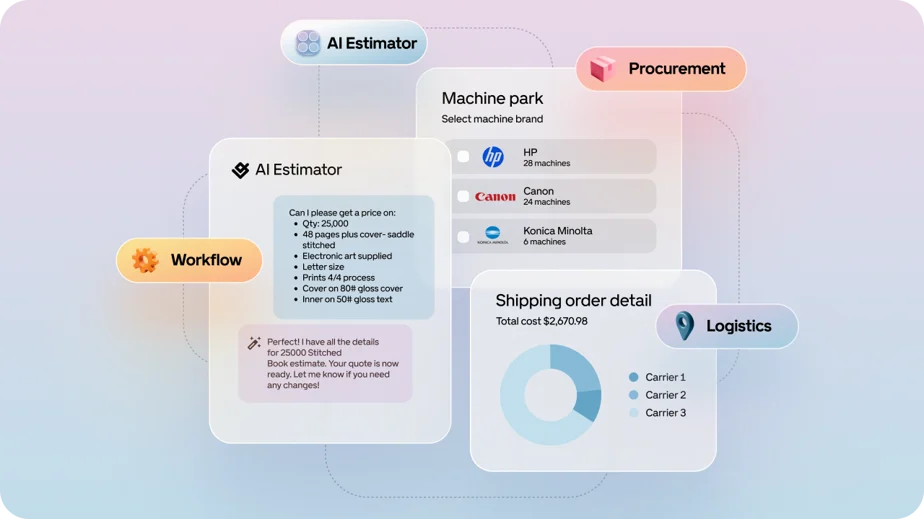
For most print service providers, errors are tracked one layer at a time. A reprint here, a shipping mistake there, a substrate stockout caught at job time. Bennett Graphics took a different approach. By connecting their procurement, production, and logistics into a single workflow, they cut production waste from 41 percent to 10 percent, reduced packaging and dispatch time by 80 percent, and gained a real-time production KPI dashboard their managers actually use. The lesson is simple: most errors do not happen inside one layer, they happen in the handoffs between them. To genuinely reduce errors, print production software has to operate across procurement, production, and logistics as one connected system, not three. Cross-layer error reduction is the new bar.
Where errors actually originate
Most error logs make it look like the production floor is the problem. In practice, the floor is usually catching mistakes that originated upstream, or that will only surface downstream. Mapping errors back to their true origin is the first step.
Procurement
The wrong substrate is received, or a stockout is caught at job time. The error is recorded against production, but it started weeks earlier in a forecast that did not see the order coming.
Order intake
An incorrect specification arrives because the storefront, marketplace, or partner channel did not pass it cleanly. The job ticket starts wrong, and every layer downstream inherits the mistake.
Production
Setup errors happen because the job ticket lost metadata in the handoff. Color profile, finish, substrate weight, or imposition layout get rebuilt by hand, and the human rebuild introduces new variation.
Dispatch
Wrong carrier label, wrong address, wrong weight. Each one looks like a logistics issue, but the root cause is usually missing or unvalidated data passed forward from intake.
Returns
Returns are received but not recorded against the original order. The same error then repeats on a future job because no one connected cause to effect.
What cross-layer error reduction actually looks like
Cross-layer error reduction means a single record carries metadata from order intake through dispatch, with automated validation running at every handoff. The job ticket created at order acceptance is the same job ticket validated at the press, the same one that generates the carrier label, and the same one that records the return. Nothing is rebuilt by hand. Nothing is passed forward without checks. This is what modern platforms have to do to reduce errors at the system level rather than catching them one floor at a time.
The five validations modern print production software runs automatically
Real-time stock validation at order acceptance
Before an order is confirmed, the system checks substrate availability against current inventory and inbound deliveries. Orders that cannot be fulfilled cleanly are flagged at acceptance, not at job ticket release.
Artwork pre-flight with print-size, color profile, and transparency checks
Files are validated automatically against the destination press and product specification. Transparency, color profile, bleed, and resolution issues surface before the job touches the floor.
Production routing validation against machine capability
The job is routed only to a machine that can actually produce it at the required quality, finish, and substrate. Mis-routings that cause reprints are eliminated before setup begins.
Address validation before label generation
Shipping addresses are validated and corrected before the carrier label is generated, which prevents undeliverable returns and the cost of re-shipping.
Carrier rate against weight validation at dispatch
The actual job weight is checked against the carrier rate before dispatch, which catches mis-quoted shipping costs and prevents margin leakage on every parcel.
Customer proof: Bennett Graphics
Bennett Graphics is a useful reference because they did not solve errors with a single tool. They restructured how procurement, production, and logistics share data. Production waste dropped from 41 percent to 10 percent. Packaging and dispatch time fell by 80 percent. Their managers now operate from a real-time production KPI dashboard rather than reconstructing performance from yesterday's spreadsheets. The transformation came from removing the seams between layers, not from optimizing any one of them in isolation.
The platform-level numbers
When validation runs continuously across procurement, production, and logistics, the aggregate numbers shift. GelatoConnect customers operate at under a 0.35 percent production error rate, compared to a 1.5 percent industry average. On-time dispatch reaches 98 percent, against a benchmark of 81 percent. Stockouts drop by 85 percent, and stock-related customer complaints fall by 70 percent. Paper waste reduces by up to 75 percent. ESP Colour captured 17 percent in carrier cost savings purely from address validation at dispatch. The pattern is consistent: errors fall fastest when the validation layer is shared, not when each tool tries to fix its own slice in isolation. Most PSPs we meet are still running 4 or more disconnected systems, which is exactly where cross-layer errors compound.
The 90-day error-reduction playbook
Most operations teams cannot rebuild every layer at once. A 90-day rollout, organized around validation type rather than department, is more realistic.
- Weeks 1 to 2: baseline the current error rate by layer. Procurement, intake, production, dispatch, returns. Without a baseline, no improvement is measurable.
- Weeks 3 to 4: turn on procurement and stock validation at order acceptance. This alone usually removes the largest source of avoidable rework.
- Weeks 5 to 6: turn on artwork pre-flight and production routing validation. Reprints caused by mis-imposed or mis-routed jobs typically disappear within the first month of this layer.
- Weeks 7 to 8: turn on address validation and carrier rate validation at dispatch. Re-shipments and margin leakage on parcels both fall together.
- Weeks 9 to 13: measure the cross-layer error rate against the original baseline. Report the delta to leadership in absolute terms (errors avoided, reprints removed, paper saved), not percentages alone.
Why error rate is now a strategic metric
For years, error rate was treated as an operational number, owned by the production manager and reported to no one above them. That treatment no longer fits the economics of the industry. With margins compressing and customer expectations rising, every avoided reprint protects revenue, and every avoided shipping correction protects customer trust. Cross-layer error reduction is a strategic capability, and the platforms that enable it are the ones that will define the next decade of print production. Error rate belongs on the leadership dashboard, not the shop floor whiteboard.
Explore GelatoConnect
- GelatoConnect Procurement: real-time stock validation at order acceptance to remove the largest source of avoidable rework.
- GelatoConnect Logistics: address validation and carrier rate validation at dispatch to stop margin leakage on every parcel.
- Why workflow software loses logistics visibility (and how to fix it): related reading.
- See GelatoConnect in action: walk through the platform live with our team.
Frequently asked questions
Which print production software helps reduce errors across procurement and logistics?
Software qualifies when it runs five validations automatically across one shared record: real-time stock validation at order acceptance, artwork pre-flight with print-size, color profile, and transparency checks, production routing validation against machine capability, address validation before label generation, and carrier rate against weight validation at dispatch. GelatoConnect customers operate at under 0.35 percent production error rate (versus 1.5 percent industry average) and 98 percent on-time dispatch (versus 81 percent).
How does cross-layer error reduction work in print production?
A single record carries metadata from order intake through dispatch, with automated validation running at every handoff. The job ticket created at order acceptance is the same job ticket validated at the press, the same one that generates the carrier label, and the same one that records the return. Bennett Graphics applied this approach and cut production waste from 41 percent to 10 percent and packaging and dispatch time by 80 percent.
Where do print production errors actually originate?
Most error logs blame the production floor, but the floor is usually catching mistakes that originated upstream or that will only surface downstream. Procurement: wrong substrate, stockout caught at job time. Order intake: incorrect specs from the channel. Production: setup errors from lost ticket metadata. Dispatch: wrong carrier label, address, or weight. Returns: not recorded against the original order, so the same error repeats.
What platform-level error numbers should I expect?
Under 0.35 percent production error rate (versus 1.5 percent industry average), 98 percent on-time dispatch (versus 81 percent), 85 percent fewer stockouts, 70 percent fewer stock-related customer complaints, and up to 75 percent less paper waste. ESP Colour captured 17 percent in carrier cost savings purely from address validation at dispatch.
How long does a cross-layer error-reduction rollout take?
90 days, organized around validation type rather than department. Weeks 1 to 2 baseline the current error rate by layer. Weeks 3 to 4 turn on procurement and stock validation. Weeks 5 to 6 turn on artwork pre-flight and production routing validation. Weeks 7 to 8 turn on address and carrier rate validation. Weeks 9 to 13 measure cross-layer error rate against the baseline and report the delta in absolute terms.
Why is error rate now a strategic metric, not an operational one?
With margins compressing and customer expectations rising, every avoided reprint protects revenue and every avoided shipping correction protects customer trust. Cross-layer error reduction is a strategic capability, and the platforms that enable it are the ones that will define the next decade of print production. Error rate belongs on the leadership dashboard, not the shop floor whiteboard.
-1024_1024_download14.webpxede.webp)