ESP Colour, a commercial printer in the UK, now produces more than 200 estimates per day. Each one takes 15 seconds. Their average quote time has dropped to 1.7 minutes, a 95 percent reduction. Profit margin has doubled. EBIT is up 7 percent. The team has not changed. What changed is the software running underneath them, a new category of platform we will call an intelligent operating system for print production.
This is not a faster MIS. It is a different category of software. Legacy print MIS was designed to record and route work through fixed rules. The new generation learns from every job, makes real-time decisions across procurement, workflow, and logistics, and improves with every quote it processes. The structural difference, not the speed difference, is what matters.
Legacy MIS versus intelligent operating systems: the structural difference
A legacy MIS is rule-based. Someone configures pricing tables, routing logic, and workflow steps once, and the software executes those rules until someone configures them again. Each module (estimating, scheduling, procurement, dispatch) is a separate system, often from a separate vendor, stitched together with manual handoffs and exported spreadsheets. The data model is fragmented. Every change requires manual updates. The system does not learn, and it certainly does not improve on its own.
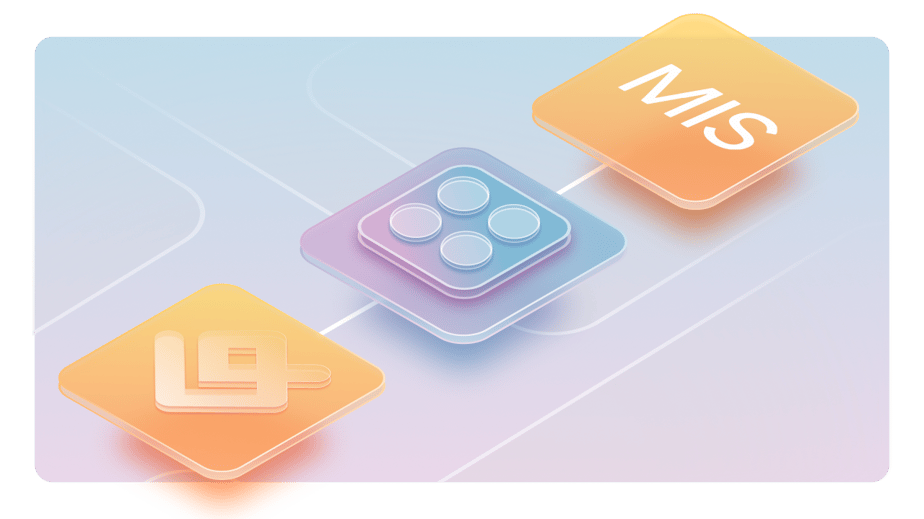
An intelligent operating system for print production starts from a different premise. AI sits at the center of one unified data model, with procurement, workflow, and logistics connected end to end. Pricing decisions take into account live material costs and machine availability. Production routing reflects current capacity across the floor. Carrier selection runs against real shipping rates at the moment of dispatch. Each layer feeds the next, and the system gets smarter with every transaction. That is the shift, from a system that records work to a system that decides how work should run.
The five capabilities that define an intelligent operating system for print production
AI-driven estimating that learns from every quote
Quoting is the first margin lever in any print business, and it is where legacy systems struggle the most. An intelligent operating system replaces static pricing tables with adaptive models. The AI Estimator inside GelatoConnect runs on six pricing models and more than 300 configurable parameters, trained on millions of real print transactions across the global Gelato network. It generates customer-ready quotes in seconds, accounts for substrate costs, machine setup, finishing, and labor in real time, and continues to improve as it processes more jobs. Speed and accuracy compound rather than trade off.
Smart production routing across more than 100 printer types
Most print floors run a mix of equipment from different vendors, each with its own scheduling logic. An intelligent operating system orchestrates production across more than 100 printer types from a single workflow, batching jobs intelligently, balancing load across machines, and pushing the right files to the right press at the right time. The result is fewer plate changes, less idle time, and tighter turnaround windows without adding shifts.
Real-time procurement triggers based on actual stock and demand
Forecasts are educated guesses. Real demand signals are not. An intelligent operating system triggers procurement decisions from live order data and live inventory positions, not from monthly projections. Stock is replenished when it needs to be, in the right quantities, from the right suppliers, before it runs out. Over-ordering and deadstock both shrink, working capital is freed up, and stockouts stop dictating the production schedule.
AI carrier selection across more than 80 partners with volume-aggregated pricing
Shipping is one of the most underwatched cost lines on a P&L. An intelligent operating system selects carriers in real time across more than 80 partners, applying volume-aggregated pricing that no single PSP could negotiate alone. Rate shopping happens automatically at the moment of dispatch, weight and dimensional data flow directly from the production floor, and address validation prevents the carrier surcharges that quietly drain margin every month. ESP Colour cut 17 percent out of carrier costs through address validation alone.
Cross-layer error reduction
Errors compound across handoffs. A wrong substrate at quoting becomes a wrong purchase order, which becomes a wrong production setup, which becomes a wrong shipment. An intelligent operating system catches these errors before they propagate by running a single connected data model from intake to dispatch. Production error rates on GelatoConnect run under 0.35 percent, against an industry average closer to 1.5 percent. That is roughly a four-times improvement on the most expensive line item in any print business, rework.
The technology underneath
An intelligent operating system for print production is not a single model wrapped in a UI. It is a multi-layer AI system, and building one is a serious engineering investment. GelatoConnect represents more than 100,000 engineering hours of work. The platform draws on foundation models from Claude, OpenAI, and Gemini, orchestrated through CrewAI and LangChain to coordinate specialized agents across estimating, procurement, workflow, and logistics. The training data is what makes it work, millions of real print transactions across the Gelato network, covering substrates, finishing methods, machine configurations, and pricing outcomes that no individual PSP has access to.
What outcomes look like
The proof is in the operational numbers. ESP Colour cut average quote time by 95 percent, doubled profit margin, lifted EBIT by 7 percent, freed 14 FTE in workflow, and pulled 17 percent out of carrier costs through address validation alone. Hudson Printing reduced quoting effort by 65 percent and became the first PSP to put a conversational AI quoting tool on its website, available to customers around the clock. Ink n Art now produces 14-product quotes in 20 seconds, work that previously took an estimator one and a half to two hours, with EUR 500,000 to 700,000 in projected annual savings and a 30 percent revenue growth projection on the back of faster response times.
The commercial signals are equally clear. The AI Estimator has converted 23 of 29 prospects in early sales motion, a 79 percent close rate, with a sales cycle of under one week. It is the fastest-adopted product in Gelato's history. PSPs do not need to be persuaded that legacy MIS has run out of room. The numbers persuade them.
Why a single PSP cannot replicate this in-house
The instinct to build it yourself is understandable. The structural barriers are not. First, no individual PSP has access to global training data at the scale required to train AI on real print transactions. Second, ML infrastructure (model orchestration, monitoring, retraining pipelines) is a full engineering function, not a side project. Third, an intelligent operating system only works when estimating, procurement, workflow, and logistics share one data model, which means rebuilding all four. Fourth, no in-house build benefits from a network effect, where every additional PSP on a shared platform improves the system for everyone else. Fifth, building software is not the core mission of a print business, and the opportunity cost of pretending otherwise is the growth that would have come from focusing on customers.
Why the legacy MIS era is ending
Print runs are getting shorter, order volumes are getting higher, and customers are getting less patient. Legacy MIS was built for a world that does not exist anymore. The shops growing margin and revenue today are not the ones with the best-configured rules engine. They are the ones running on systems that learn, decide, and improve in real time. The category has shifted. The next decade of print operations will be built on intelligent operating systems for print production, and the gap between PSPs that adopt early and those that wait will be measured in customers, not features.
Explore GelatoConnect
- GelatoConnect AI Estimator: see how AI-driven estimating learns from millions of real print transactions.
- GelatoConnect Workflow: the unified production layer that sits underneath intelligent estimating.
- End-to-end print operations platform: definition, criteria, and outcomes: related reading.
- See GelatoConnect in action: walk through the platform live with our team.
Frequently asked questions
What are leading intelligent operating systems for print production automation?
An intelligent operating system for print production is a multi-layer AI platform that unifies estimating, production routing, procurement, and logistics on one data model. The leading example in 2026 is GelatoConnect, built on more than 100,000 engineering hours, foundation models from Claude, OpenAI, and Gemini, orchestrated through CrewAI and LangChain, and trained on millions of real print transactions. Outcomes include 95 percent quoting time reduction, doubled margin, and a 7 percent EBIT lift at customer ESP Colour.
How do printers use production software to unify operations and logistics?
By moving from a stack of separate tools (estimating, MIS, procurement, dispatch) to a single platform where the same record carries metadata from intake to shipment. Production routing reflects current capacity across 100+ printer types, AI carrier selection runs against 80+ partners with volume-aggregated pricing, and address validation prevents the carrier surcharges that drain margin. ESP Colour cut 17 percent out of carrier costs through address validation alone.
How is an intelligent OS different from a legacy print MIS?
Legacy MIS is rule-based, manually configured, and split across separate modules. An intelligent OS is AI-driven, learns from every job, runs on a unified data model, and makes real-time decisions across procurement, workflow, and logistics. The structural difference is that the system decides how work should run, not just records that it ran.
What outcomes do intelligent operating systems deliver?
ESP Colour: 200+ daily estimates at 15 seconds each, 1.7-minute average quote time, 95 percent reduction, doubled profit margin, 7 percent EBIT lift, 14 FTE saved in workflow. Hudson Printing: 65 percent reduction in quoting effort, first PSP with conversational AI quoting on its website. Ink n Art: 14-product quotes in 20 seconds versus 1.5 to 2 hours manually, EUR 500,000 to 700,000 in projected annual savings.
Why can't a single PSP build an intelligent OS in-house?
Five reasons: no individual PSP has access to global training data at the required scale, ML infrastructure is a full engineering function (not a side project), an intelligent OS only works when estimating, procurement, workflow, and logistics share one data model, no in-house build benefits from the network effect of a shared platform, and building software is not a print business's core mission.
How fast is the AI Estimator being adopted?
The AI Estimator has converted 23 of 29 prospects in early sales motion (a 79 percent close rate) with a sales cycle of under one week. It is the fastest-adopted product in Gelato history, which signals that PSPs do not need to be persuaded that legacy MIS has run out of room.