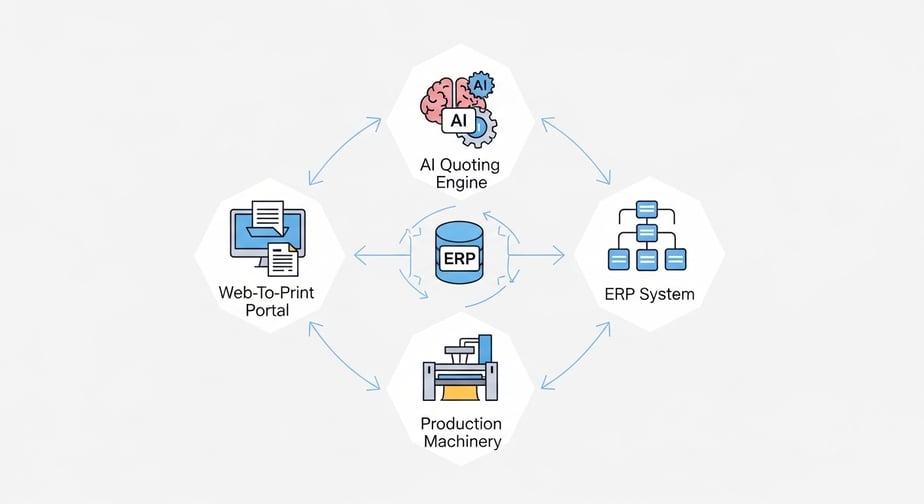
PSPs that move their corporate B2B portals to native integration typically see 10 to 25 percent lower operational costs across the GelatoConnect platform. That benchmark points to a quieter truth about the true third-party B2B print portal cost: most PSPs price it at the line-item subscription fee on their vendor invoice, and that line item is usually less than half of what the portal is actually costing the business. Per-change fees, per-storefront surcharges, manual order re-entry, launch delays, and revenue leakage all sit underneath the subscription, rarely showing up in the same place. This article breaks the five hidden buckets down so finance, operations, and ownership can model what a B2B portal is really costing today, and what the upside looks like if that cost moves onto a native integration.
Hidden cost 1: per-change fees that compound quietly
Every B2B portal change looks small on its own. A catalog update when a corporate client adds three new SKUs. A banner swap for a Q4 promotion. A price change after a paper cost increase. Each one gets quoted as a support ticket, and each ticket typically lands between $250 and $2,000 depending on scope. For a single portal serving one corporate client, that can feel manageable.
Scale it to 50 corporate portals, each making a handful of changes a year, and the picture shifts. Twelve to fifteen catalog or banner updates across the fleet per quarter is not unusual, and at an average of $300 per change, that is roughly $4,500 a quarter. Over a year it compounds into a mid-five-figure line that was never in the original budget and rarely surfaces in a quarterly review.
Hidden cost 2: per-storefront surcharges on "unlimited" plans
Most B2B portal contracts are sold with "unlimited storefronts" language. In practice, unlimited often means unlimited within a tier, and each tier has a storefront ceiling. Cross it, and you are into overage territory, typically $40 to $80 per storefront per month.
A PSP that wins a burst of new corporate accounts, for example six new clients in a single quarter, can trip into the next pricing band without realizing it. The overage is rarely flagged at the time of the win, which means the first sign is a surprise line item on the following quarter's invoice. Once you are there, the only way back down is to consolidate or churn a storefront, neither of which is a conversation you want to have with a paying corporate client.
Hidden cost 3: manual order re-entry labor
This is the cost that hides in plain sight, because it shows up as headcount rather than a vendor invoice. When orders arrive from a third-party B2B portal but are not natively integrated with your production system, someone has to rekey them. Order details, shipping, artwork references, imposition notes.
The math is straightforward. At 5 minutes per order and a fully loaded labor cost of $25 per hour, each rekeyed order costs about $2.08. A PSP processing 2,000 corporate portal orders per month is paying roughly $4,150 per month, or $49,800 per year, just to move data from one system into another. No margin is created in those five minutes, and every manually rekeyed order is another chance to introduce an error that shows up later as a return, a reprint, or an angry account manager.
Hidden cost 4: months-to-launch delays and deferred revenue
Onboarding a new corporate client onto a third-party B2B portal is a project, not a click. Six weeks is a common benchmark from contract signature to live storefront, and those six weeks are not free.
Every week the storefront is not live is a week the client is not ordering through it. If an average corporate client is worth $8,000 a month once they are running, a six-week launch delay represents roughly $12,000 in deferred revenue per client. Win six new corporate accounts in a year, and that is $72,000 sitting in a pipeline spreadsheet instead of landing in the P&L. Deferred revenue is not the same as lost revenue, but for a PSP managing cash flow and quarterly margin targets, the distinction is smaller than it looks.
Hidden cost 5: revenue leaving the ecosystem
The fifth cost is the one least often modeled. Third-party B2B portals typically come with their own marketplaces, print networks, or adjacent fulfillment offerings. When a corporate buyer needs a product category that sits outside your catalog, a run of apparel, a packaging item, a large-format piece, the portal vendor is more than happy to route that order through their own network.
The order never touches your facility. You still pay the subscription, the buyer still uses the portal under your client relationship, but the revenue goes somewhere else. It is a quiet form of leakage, and because it never appears on your invoice, it rarely makes it into your cost model at all.
Adding it up: an illustrative model for a 50-portal PSP
The table below is an illustrative model, not a customer-specific number. It assumes a PSP running 50 corporate B2B portals, processing 2,000 portal orders per month, winning six new corporate clients per year, and operating on typical third-party portal pricing.
| Hidden cost bucket | Annual impact |
|---|---|
| Per-change fees | $18,000 |
| Per-storefront surcharges | $24,000 |
| Manual order re-entry labor | $49,800 |
| Deferred revenue from launch delays (6 new clients) | $72,000 |
| Total hidden cost, before revenue leakage | ~$163,800 |
Revenue leakage sits outside the total because it is harder to model without facility-specific data on product mix. Even excluding it, the hidden cost in this illustrative model runs several multiples of the visible subscription fee.
What native integration changes
Native integration collapses the five buckets back into a single line. Orders flow directly from the storefront into production without re-entry. Catalog, pricing, and banner changes are managed by your team rather than invoiced per ticket. Storefront counts stop triggering tier overages. New corporate clients launch in days rather than weeks. Product categories that would otherwise leak to an outside network stay inside your ecosystem.
Across the GelatoConnect platform, PSPs that make the switch see 10 to 25 percent lower operational costs, 25 to 100 percent growth without extra hiring, and 3 to 7 percentage points of margin improvement. Most PSPs run on 4 or more disconnected systems today, and the B2B portal is often the noisiest of them. The subscription line stays on the P&L after the switch. The difference is that it is no longer hiding four bigger ones underneath it.
Explore GelatoConnect
- GelatoConnect Store Link: Web-to-Print: see how the product works end to end.
- B2B print portal playbook: launch in hours not months
- See GelatoConnect in action: walk through the platform live.
Frequently asked questions
What are the hidden costs of a third-party B2B print portal?
Five buckets: per-change fees ($250 to $2,000 per ticket), per-storefront surcharges when "unlimited" plans trip an overage, manual order re-entry labor (~$2.08 per order at $25/hour and 5 minutes per rekey), deferred revenue from launch delays (often 6 weeks per new corporate client), and revenue leakage when the portal vendor routes product categories through their own network.
How much can hidden costs add up to annually?
For a PSP running 50 corporate portals, an illustrative model puts the annual hidden cost around $163,800: $18,000 in per-change fees, $24,000 in storefront surcharges, $49,800 in manual re-entry labor, and $72,000 in deferred revenue from launch delays. That is before revenue leakage from cross-ecosystem routing.
How does native integration change the cost structure?
Native integration collapses the five buckets back into a single line. Orders flow from storefront to production with no re-entry, catalog and pricing changes are self-serve at zero cost, storefront counts stop triggering tier overages, and new clients launch in days rather than weeks. Across GelatoConnect, PSPs see 10 to 25 percent lower operational costs and 3 to 7 percentage points of margin improvement after the switch.
Why do per-change fees compound so fast?
Legacy portals treat every edit as a support ticket. A logo tweak, a price update, and a banner swap each run $250 to $2,000. Across a fleet of 50 portals, 12 to 15 changes per quarter is typical, and an average $300 per change reaches roughly $18,000 a year from the smallest invoice line.
How is manual order re-entry labor calculated?
At 5 minutes per order and a fully loaded labor cost of $25 per hour, each manually rekeyed order costs about $2.08. A PSP processing 2,000 portal orders per month pays approximately $4,150 per month, or $49,800 per year, just to move data between the portal and production. No margin is created in that time.
What is revenue leakage and why is it so hard to model?
When a corporate buyer needs a product outside your catalog, many third-party portals route that order through their own marketplace or network. You still pay the subscription, the client still uses the portal, but the revenue goes to a competitor. It rarely shows up on your invoice, which is why it almost never makes it into cost models.