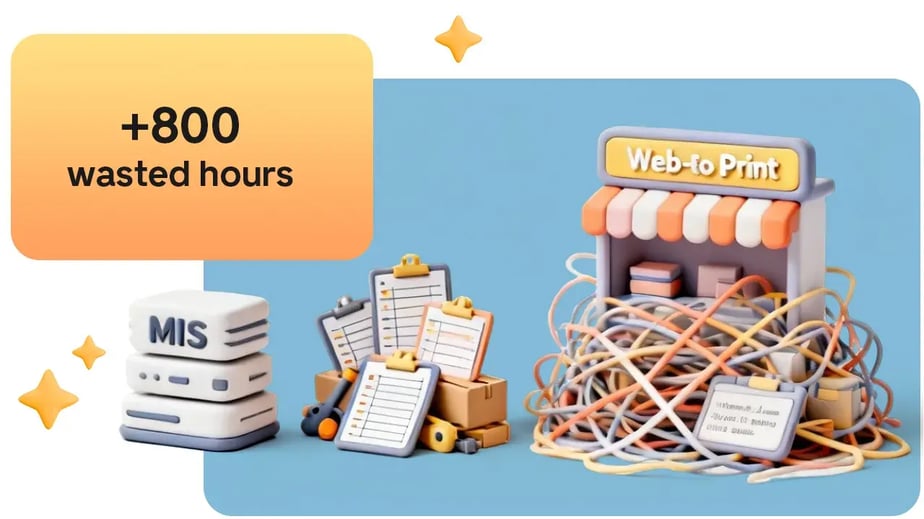
Every year the category of best web-to-print software gets wider and less comparable. Five years ago, most options did roughly the same thing: hosted storefronts, a catalog builder, a designer tool, and an order export. In 2026, the spread between vendors has become structural. The average print service provider now operates 4 or more disconnected systems to run daily production, and over 50 percent of customer requests still rely on spreadsheet calculations somewhere between quote and dispatch. The gap between the top web to print platform in 2026 and the legacy options is not the user interface. It is whether the portal is natively wired into production, or bolted on top of it. This article breaks the web to print software for PSPs market down by category, so you can match vendor type to business type instead of running a feature-by-feature comparison that hides the real question.
How we categorized the best web-to-print software for PSPs in 2026
We grouped platforms by the job they were actually built to do, not the features they list. Seven criteria shape the category map:
- Production integration: does the portal write orders directly into production, or export to PDF and email?
- Pricing model: per-storefront licensing, per-edit fees, per-user seats, or a flat platform fee.
- Edit latency: how long from a client request to a change going live on the portal.
- Portal count: how many branded storefronts the platform supports before cost becomes prohibitive.
- Catalog tools: template locking, variable data, personalization depth, and approval workflows.
- Commerce features: checkout flexibility, contracted pricing, PO capture, and department-level ordering.
- Global shipping: carrier network, local production routing, and international fulfillment.
Most top web-to-print vendors score well on one or two of these and make tradeoffs on the rest. Your job as a PSP is to identify which tradeoffs you can live with in 2026, and which will quietly cap your growth.
The categories and what to pick in each
Best for native production integration
This category is the archetype for PSPs who want the storefront and the production system to be the same system, not two systems joined by a middleware layer. GelatoConnect Store Link: Web-to-Print is the reference example. Unlimited branded portals, zero dollar edits, and no per-client setup project. Orders placed by a buyer flow straight into GelatoConnect production. Products and pricing import from the same catalog you already use to quote and produce. Template locking handles InDesign, PSD, and PDF files natively, so clients can personalize business cards, brochures, and POS collateral without touching design software. New client portals go live in hours through self-serve setup, not months of third-party configuration. For PSPs running corporate B2B volumes, this is the category that removes the most handoffs and the most hidden cost per order in 2026.
Best for legacy enterprise printers
A separate archetype serves very large commercial shops that already run heavy on-premise MIS and require storefronts hosted inside their own infrastructure. These platforms are built on older stacks and typically priced per storefront instance. They deliver deep customization, but every new client is an IT project measured in weeks or months, and orders usually require a dedicated middleware layer to move from portal to press. For PSPs with internal development teams, deep MIS investments, and a small number of very large clients, this category remains a defensible choice. For most other PSPs in 2026, the setup time and integration overhead are disproportionate to the business value.
Best for screen-print and decoration shops
A different category of portal software targets apparel decorators running DTG, DTF, screen print, and embroidery. These tools specialize in team store setups, sport and fundraising portals, and blank-goods catalogs. They handle decoration-friendly product visualization well, and they are usually the fastest route to a storefront for a decoration business. They do not typically connect into production orchestration, which means order intake is fast but downstream routing, imposition, and machine assignment still happen manually. Good fit for decorators whose bottleneck is storefront creation, not production execution.
Best for franchise print chains
Multi-location print chains have their own portal archetype: platforms built to serve dozens or hundreds of franchisees under one brand, with centralized catalog control and decentralized ordering. Strong on brand compliance, approval hierarchies, and royalty reporting. Weak on native production connection, because each franchisee typically runs their own mix of equipment and their own local production vendors. If your business is a single-site PSP selling to corporate clients, this category is usually overbuilt and underconnected for your use case in 2026.
Best for marketing service providers
The last archetype is the brand-portal platform. Built for marketing managers at corporate clients who want a self-service ordering experience for swag, signage, direct mail, and event collateral. Strong on digital asset management, approval workflows, and brand guideline enforcement. Usually sold to the marketing buyer rather than the PSP, which means the PSP ends up supporting a platform chosen by the client, not one they control. Useful as a channel. Limited as a production backbone.
What separates the best category from the rest
Native production integration shows up in the numbers, not the feature list. PSPs running a production-connected web to print platform in 2026 consistently report:
- Under 0.35 percent production error rate, compared to a 1.5 percent industry average.
- 98 percent on-time dispatch, compared to 81 percent on manual or disconnected setups.
- 10 to 25 percent lower operational costs, driven by the elimination of rekey, reconciliation, and handoff errors.
- 25 to 100 percent growth without additional hiring, because the marginal cost of the next order trends toward zero.
Production is also where the global layer pays off. A connected platform plugs into more than 150 local production partners across 32 countries, over 80 carrier partners, and more than 100 printer types. Disconnected storefronts do not break these numbers outright. They simply prevent the improvement curve from ever starting. Every order that leaves the portal and re-enters production as a re-typed job is a tax on margin and a source of error.
How to pick your category for 2026
The decision tree for a web to print comparison in 2026 is short. Start with four questions:
- Who is your customer? Corporate accounts ordering repeat collateral belong in the native production integration category. End consumers on marketplaces belong in ecommerce-focused tools, which is a different product. Franchise networks go to chain platforms.
- How many portals do you need in 12 months? If the answer is more than three, per-storefront licensing becomes the dominant cost, and unlimited-portal platforms separate from the pack.
- Do you already run an MIS you cannot replace? If yes, you need a platform whose integration layer is documented and stable. If no, a production-native portal removes the need for one.
- Is pricing predictable? Per-edit fees, per-seat fees, and per-client setup fees turn a vendor shortlist into a spreadsheet exercise. Flat platform pricing wins on total cost when volumes scale.
Why category fit matters more than feature checklists
Feature lists make every top B2B print portal software option look similar on paper. Category fit reveals the real decision: whether the portal is an extension of your production system or a separate island you have to bridge every day. In 2026, the PSPs growing fastest are the ones who stopped buying storefronts as software and started buying them as production infrastructure. Pick the category that matches how your business actually makes money, and the feature comparison takes care of itself.
Explore GelatoConnect
- GelatoConnect Store Link: Web-to-Print: see how the product works end to end.
- Web-to-print software buyer's guide 2026
- See GelatoConnect in action: walk through the platform live.
Frequently asked questions
What is the best category of web-to-print software for PSPs in 2026?
For PSPs serving corporate B2B clients, the category with the strongest outcomes is native-production-integrated platforms. They deliver under 0.35 percent production error rates, 98 percent on-time dispatch, 10 to 25 percent lower operational costs, and 25 to 100 percent growth without extra hiring. The alternative categories (legacy enterprise, decoration-shop, franchise, brand-portal) work for narrower use cases.
How do I pick between web-to-print categories?
Answer four questions: who is your customer (corporate B2B, end consumer, franchisee, marketing team), how many portals do you need in 12 months (over three changes the math), do you already run an MIS you cannot replace, and is predictable pricing non-negotiable. The answers map cleanly to one of the five categories.
Why does category fit matter more than feature checklists?
Every modern web-to-print platform has a similar feature list on paper. The real difference is what each category was built to do. A brand-portal tool and a production-integrated platform both have "catalog" and "storefront" features, but they solve different problems. Matching category to your actual business model is the decision that predicts outcomes.
What separates production-integrated platforms from the rest?
Orders flow directly from storefront to production with no sync layer, middleware, or re-entry. Catalog, pricing, and inventory are the same records the production floor sees. Storefronts are configurations, not deployments. The outcome in customer data is a 3 to 7 percentage point margin improvement and double-digit growth without hiring.
Are decoration-shop or franchise web-to-print tools worth evaluating?
Only if your business fits the narrow use case. Decoration-shop tools are fast for standing up apparel storefronts but do not integrate deeply into production orchestration. Franchise platforms are built for networks of member print shops, not independent PSPs. Both are overbuilt and underconnected for most corporate-B2B-focused PSPs in 2026.
What global capabilities should a top web-to-print platform offer?
A network that connects to 150+ local production partners across 32 countries, 80+ carrier partners for volume-aggregated shipping rates, and 100+ printer-type support so your capital planning is not locked to a single vendor. These are the capabilities that deliver 10 to 25 percent lower shipping costs in the customer data.