The #1 thing profitable print shops do differently (it's not what you'd expect)
The most profitable print shops in the industry aren't running faster equipment, investing in cutting-edge technology, or grinding harder than their competitors. They're doing something much simpler: they removed human decision-making from low-value work and let systems handle what systems do better. The best performing shops start with quoting, then expand that automation across procurement, workflow, inventory, and logistics. That single decision multiplies the entire operation.
The shops that are struggling tend to do the opposite. They add more processes, hire more people to manage those processes, and create more complexity. More moving parts equal more opportunities for failure and less margin to absorb it.
The profitability pattern across top performing shops
Look at ESP Colour, Ink n Art, WeMust, Xpress, and TidyMerch. These are shops across Europe and beyond that are achieving 3-7 percentage point margin improvement while growing 25-100% year-over-year. They have something in common: they all removed human decision-making from the work that was making their digital operations unprofitable.
For ESP Colour, that started with quoting. EBIT improved 7 percentage points because they stopped having estimators manually price every job. Consistent pricing, fast turnaround, higher conversion. Profitability and volume growth happened simultaneously.
For Ink n Art, an Italian commercial printer, the breakthrough was similar but broader. They implemented AI Estimator to automate quoting, but they also automated procurement and logistics with GelatoConnect. The cumulative effect: EUR 500K-700K in projected annual savings with 30% revenue growth in one year.
These aren't shops that found better customers or grew into a better market. They're shops that removed the operational drag that makes small-order, high-volume digital print unprofitable.
Why growth without automation breaks margins
Here's the core problem that most print shops face: digital print economics don't scale linearly with headcount. When you double your volume, you don't need to double your team. You need to eliminate the low-value manual work that was creating the appearance of needing more people.
A shop growing from $1M to $2M revenue without automation will try to hire their way through. More sales staff to handle leads. More estimators to generate quotes faster. More production coordinators to manage job flow. More customer service people to handle more inquiries. Every 100% growth looks like it requires 30-40% more payroll.
But margins collapse because you're adding fixed cost to a business that's fundamentally about volume. Each hire adds overhead. Each new hire brings training cost, management overhead, and potential productivity loss. At $2M revenue, you're now running the same operation as shops with margin advantage because they automated first.
TidyMerch proved you can do the opposite. They grew 100% in a year without adding production headcount because they automated the work that would have required five new hires. That single decision freed capital, eliminated hiring risk, and created a far more profitable operation at scale.
The automation priority list for maximum impact
Not all automation is created equal. Some automations save time. Others save time and margin simultaneously. The highest-impact automations, in order, are:
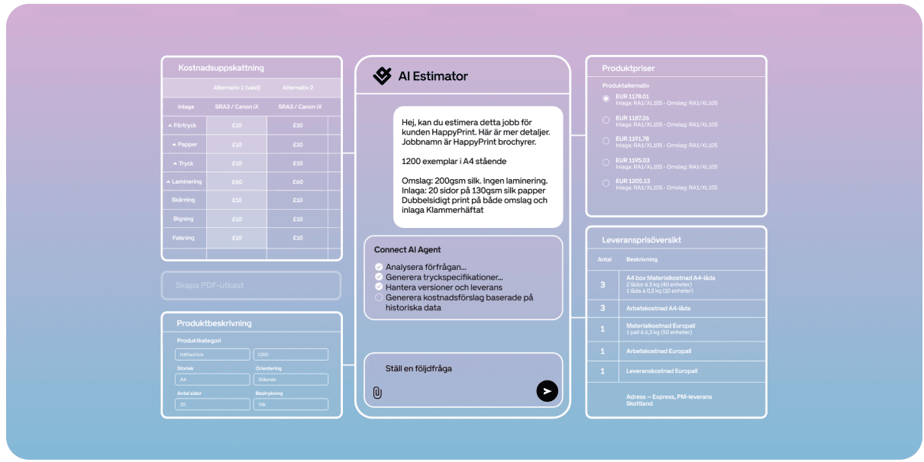
First priority: Quoting. Automate the process that directly impacts pricing consistency and sales velocity. Manual quoting takes 30-45 minutes per job, introduces pricing bias, and slows down your customer conversion. AI estimating generates quotes in 15 seconds with consistent pricing. Hudson Printing reduced quoting effort by 65% with instant customer quotes on their website.
Second priority: Procurement. Automate blank ordering, material selection, and supplier coordination. Manual procurement means stockouts, overstock, and spreadsheet tracking overhead. TidyMerch reduced procurement time from 2 hours daily to 1 minute by automating blank replenishment from integrated suppliers.
Third priority: Production workflow. Automate job routing, artwork validation, and decoration method assignment. Manual routing means sent-to-wrong-machine errors, quality rework, and coordination overhead. Unified workflow with AI preflight eliminates those errors before they become reprints.
Fourth priority: Logistics. Automate carrier selection, rate comparison, and label generation. Manual shipping coordination means paying premium rates instead of consistently lowest cost. AI carrier selection compares 100+ options and picks lowest cost per shipment automatically. TidyMerch automated label generation cut that work from 2 minutes per order to 2 seconds, saving 13 hours daily.
The math of profitable scale
Here's why this matters. A print shop growing from $2M to $5M revenue without automation needs to add approximately 15-20% more payroll. That's $300-400K in new annual salaries, benefits, and overhead. The revenue growth is only covering 60-70% of that new cost, so margins compress.
A print shop growing from $2M to $5M with automation in place (especially quoting and procurement) might add only 5-10% more payroll because the systems are doing the work that would have required more people. The revenue growth is covering 100%+ of the cost, so margins expand.
ESP Colour's 7% EBIT improvement wasn't because they got a better market. It was because they removed the manual work that was consuming margin.
Growth without headcount is the future
The PSPs that are winning in 2025 and beyond are the ones that figured out this equation: profitability scales with systems, not people. You can grow volume 2-3x without adding proportional headcount if you remove the manual work first.
Shops like WeMust, Xpress, and TidyMerch aren't exceptions. They're the template. They grew 25-100% without hiring proportionally because they automated the work first. Every other shop in their competitive set either struggles with margin compression or avoids growth because growing feels like it requires unsustainable hiring.
Key takeaway
The most profitable print shops don't work harder. They work smarter by removing human decision-making from low-value work. They automate quoting, procurement, workflow, and logistics. They grow volume without growing headcount proportionally. They expand margins while expanding capacity. This isn't a future prediction. It's already happening. The question is whether your shop is going to be part of that trend or stuck in the old playbook of hiring your way to scale.
Ready to automate your way to profitable growth? Start with GelatoConnect AI Estimator to remove quoting friction, then expand to full platform automation. Read how 4 leading PSPs make digital volume profitable without additional staff.