For decades, print service providers faced a familiar trade-off:
growth meant hiring more people.
More orders required more estimators, more coordinators, more warehouse staff. The alternative was just as painful—existing teams overwhelmed by manual work, margins quietly eroding.
As print has shifted toward digital, POD, and small-quantity orders, that trade-off has become even more pronounced.
Because the challenge isn’t demand.
It’s whether digital volume can be profitable at scale.
Today, a growing group of PSPs is proving that it can be.
They’re growing 20–100% without adding headcount. They’re processing tens of thousands of small orders with the same teams. They’re expanding margins while increasing throughput.
The difference isn’t working harder.
It’s eliminating the manual work that made digital scale uneconomic in the first place.
The volume-to-headcount trap
Traditional print operations require human intervention at every stage.
Quoting takes 30+ minutes per job.
Jobs are tracked across spreadsheets.
Inventory is checked manually.
Shipping labels are created one order at a time.
That model worked when businesses were built on fewer, higher-value offset jobs.
Digital and POD orders behave very differently.
A €30 or €50 order still requires quoting logic, workflow decisions, inventory checks, and shipping coordination. When order counts rise, manual effort grows faster than revenue.
The math becomes brutal.
Each new hire adds salary, benefits, training, and management overhead. Labor costs compound while per-order margins stay flat—or decline. Many PSPs discovered that high-volume digital work wasn’t operationally difficult to sell, but operationally unprofitable to run.
This created a growth ceiling:
- Digital opportunities declined because margins didn’t pencil out
- Volume accepted cautiously, then diluted by labor costs
- Teams stretched thin across low-value coordination work
- Errors and delays increasing with complexity
For many PSPs—especially those rooted in offset—hesitation was rational. The operating model simply didn’t support digital economics.
WeMust: proving POD scale can work from day one
When WeMust, Canada’s largest DTF transfer producer, moved into print on demand, the concern was clear.
Single-item orders are where margins usually disappear.
Most PSPs ease into POD slowly, hiring behind growth. WeMust didn’t.
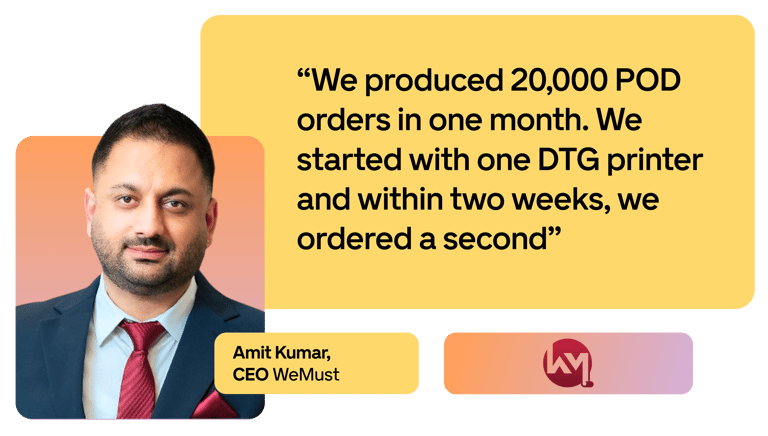 What matters isn’t just the volume. It’s what didn’t happen.
No new coordination roles.
No operational bottlenecks.
No margin collapse.
Automated workflows absorbed the order count without increasing manual effort. The confidence to invest in new equipment came not from demand alone, but from knowing the operation could scale profitably.
Xpress: turning digital order count into real revenue
At Xpress Signs & Graphics, growth showed up as more digital orders, not larger jobs.
Specific product lines scaled from 100 shipments per day to 1,000.
Under a manual model, that kind of increase would have required more staff, more oversight, and lower margins.
Instead, automation changed the equation.
-768_432_Growth2-Xpress1.pnguqsf.png)
By automating logistics and order handling end to end, high-order-count work became profitable. Shipping costs dropped. Complexity disappeared. Digital volume stopped being a risk and started being a growth engine.
Ink n Art: from unscalable to routine in five months
For Ink n Art, the issue wasn’t ambition.
It was feasibility.
Manual shipping processes and limited inventory visibility made higher daily volumes impossible.
Five months later, the operation looked fundamentally different.
-3840_2160_Growth3-InknArt1.pngeqiu.png)
This wasn’t incremental improvement. It was a structural change. Volume that once would have required multiple new hires became routine—handled by the same team, with greater control and fewer errors.
TidyMerch: digital growth without operational drag
TidyMerch faced a familiar digital dilemma: demand existed, but scaling meant more work behind the scenes.
Purchasing, stock checks, and shipping coordination made growth feel fragile.
Automation changed the economics.
-768_432_Growth4-TidyMerch1.png3za3.png)
By removing manual touchpoints across procurement and workflow, digital growth became something the business could pursue confidently, not cautiously.
The pattern across every story
These PSPs didn’t grow by pushing teams harder.
They grew by removing work.
Across WeMust, Xpress Signs, Ink n Art, and TidyMerch, the pattern is consistent:
- More orders did not mean more people
- Margins improved instead of eroding
- Digital work became strategically viable
Across top GelatoConnect PSPs:
- 25% average throughput increase
- 3–7 percentage-point margin improvement
The real breakthrough isn’t speed alone.
It’s removing human decision-making from low-value coordination work—so digital orders scale economically, not painfully.
From offset economics to digital-scale profitability
Offset operations were never designed for thousands of small orders.
But that doesn’t mean digital growth has to be unprofitable.
The PSPs growing successfully today aren’t hiring their way into digital. They’re automating end to end so that digital volume behaves economically like larger work once did.
As a result, they can say yes to opportunities others can’t afford to take on.
What this means for your operation
If you’ve historically focused on offset or longer runs, caution around digital scale is healthy.
But the constraint isn’t demand.
It’s whether your operation is built for digital economics.
When manual coordination disappears, the volume-to-headcount relationship breaks. Growth decisions can be based on market opportunity, not operational fear.
See how they did it
These results aren’t theoretical. They’re operational proof.
Read the full customer stories to see how PSPs are making digital volume profitable—without growing headcount.
Ready to transform your print operations?
Fill in the form below to request a personalized demo with the GelatoConnect team.