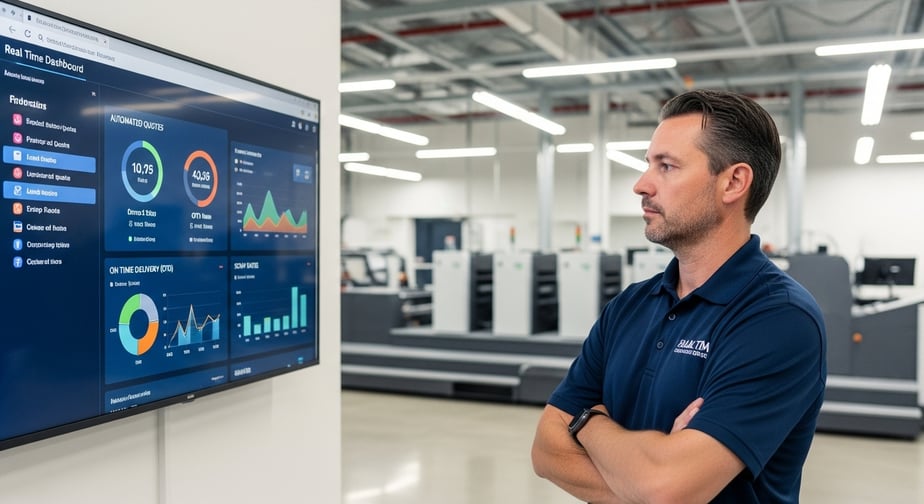
A commercial print and marketing firm recently reduced its estimating time by a staggering 80%, dropping the average time per quote from 15 minutes to under three. This wasn't achieved by hiring more staff or pushing them to work faster; it was the direct result of implementing a rules-based automated estimation engine. This single change allowed them to profitably process a higher volume of the small-to-medium jobs that now dominate the market, freeing their most experienced estimators to focus on complex, high-value projects.
As reported in a 2025 industry case study, this strategic shift directly improved their quote-to-order conversion rate. This example isn't an outlier—it's the new benchmark for operational excellence. In 2026, automated print estimation is no longer a luxury for large enterprises. It has become the central nervous system for any print provider looking to thrive in an on-demand world defined by shorter runs, tighter deadlines, and volatile costs. It's the critical first step in transforming your operations from a reactive cost center into a proactive, data-driven profit engine.
Main takeaways
For production leaders and plant managers aiming to optimize their operations in 2026, here are the essential insights on automated print estimation:
-
It’s a strategic necessity, not a feature. The market shift toward shorter, more frequent on-demand orders makes manual quoting unprofitable and unsustainable. Automation is now a requirement for survival and growth.
-
It directly improves core KPIs. By integrating with your workflow, automated estimation has a measurable impact on improving on-time delivery (OTD) to over 98% and reducing scrap rates to below 1.5% of revenue.
-
The goal is 'management by exception'. An effective strategy automates 80% of standard, repeatable quotes instantly, flagging the complex 20% for expert human review. This hybrid model balances speed with accuracy.
-
Data integrity is non-negotiable. The system is only as smart as the data it uses. Success depends on maintaining accurate, up-to-date master data on material costs, machine speeds, and labor rates.
-
It breaks the administrative bottleneck. By automating the quoting process, you remove a major constraint in your sales and order entry pipeline, allowing you to identify and address the true bottlenecks on your production floor.
-
API-first integration is key. A truly "touchless" workflow requires seamless connectivity between your estimation engine, e-commerce storefronts, ERPs, and shipping platforms.
The shifting landscape: Why manual quoting is no longer sustainable
For decades, the print estimation process remained largely unchanged: a skilled estimator would receive a request, calculate material usage, assess machine time, factor in labor, and manually produce a quote. This process, while thorough, is now a critical vulnerability. The modern print market, driven by brand demands for speed and localization, operates at a pace that manual workflows simply cannot match.
The data confirms this seismic shift. The market for software enabling this transformation is booming, projected to grow from USD 1.84 billion in 2024 to USD 3.03 billion by 2029 at a CAGR of over 10.5%, according to a report from Mordor Intelligence. This growth is a direct response to market pressures. Brands are avoiding large inventory runs, leading to a dramatic increase in the number of small quotes a print partner must handle. Simultaneously, supply chain volatility, reflected in the U.S. Bureau of Labor Statistics PPI for paper productsstrong>, means that static price lists become obsolete almost instantly. An automated system connected to supplier pricing via APIs is the only way to ensure job profitability.
This new reality requires a new operational model—one built on speed, accuracy, and data. This is precisely why leading production partners are turning to platforms like GelatoConnect. It's about more than just technology; it's about understanding the value GelatoConnect delivers by providing the tools to compete and win in this dynamic environment.
 From cost center to profit driver: The tangible ROI of automated print estimation
Implementing an automated print estimation system isn't just an IT project; it's a strategic business decision that yields a clear and measurable return on investment across your entire operation. By treating estimation as the starting point of an intelligent workflow, you can unlock significant gains in efficiency, quality, and profitability.
Slashing quote-to-order time and winning more jobs
The most immediate benefit of automation is speed. When a quote can be generated in under 60 seconds, your sales team can respond to customer inquiries almost instantly, dramatically increasing your chances of winning the order. This speed allows you to profitably pursue the high volume of short-run jobs that are increasingly common.
Furthermore, it elevates the role of your most valuable human assets. Instead of spending hours on repetitive calculations for standard jobs, your expert estimators can focus on consultative selling for complex, high-margin projects, providing value that automation cannot replicate. This is a core component of building an effective, automated print workflow management system.
Driving down operational waste and scrap rates
A robust automated estimation process does more than just calculate price; it validates the job's manufacturability from the very first step. By incorporating automated pre-flighting and validating job parameters against machine capabilities during the estimation phase, you can catch errors before they ever reach the production floor.
Leading firms that have adopted this approach are reporting scrap and rework rates below 1.5% of revenue, well below the industry benchmark, as noted in the Printing Impressions 2025 Operational Outlook. This reduction in waste flows directly to your bottom line, improving margins on every job you produce. For more insights on this, our guide explains how to calculate and reduce the cost of raw materials
 Maximizing asset uptime with intelligent routing
How do you ensure every job is produced on the most efficient machine possible? Automated print estimation provides the answer. The system's rules-based logic analyzes job attributes—such as substrate, run length, and color requirements—to determine the optimal production path.
This intelligent routing is crucial for achieving target capacity utilization of 80-85%, a key benchmark for operational excellence. It allows multi-site printers to balance workloads across their entire network, ensuring that no single plant or press becomes a bottleneck. This is where AI-powered cost and time estimation becomes a game-changer, using historical data to make increasingly smart routing decisions.
A practical blueprint: The 5 steps to a touchless workflow
Achieving a "lights out" or touchless workflow, where an order moves from intake to shipping with minimal human intervention, is the ultimate goal. Automated estimation is the engine that powers this journey. Here is a step-by-step blueprint.
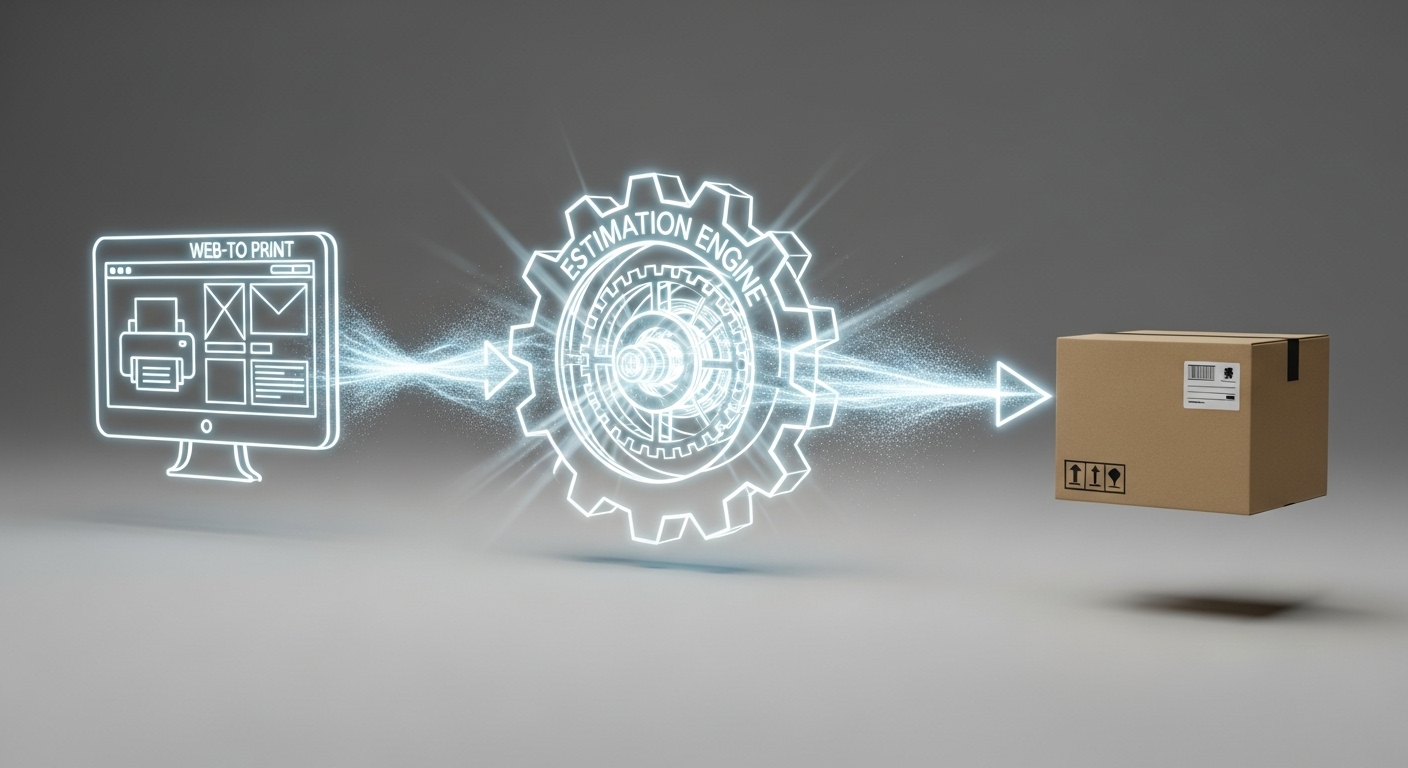
1. Automated intake: The process begins when job specifications are ingested automatically via an API from a web-to-print portal or a customer's procurement system. The goal is to capture over 99% of standard job specs without manual data entry, creating a streamlined order intake process from the start.
2. Estimation and routing: In seconds, a rules-based engine calculates costs, determines the most efficient production method (e.g., digital vs. offset), and assigns the job to a specific production line. This step should generate a customer-facing quote and an internal production plan simultaneously.
3. Automated job ticketing: Once the customer approves the quote, the system automatically creates a digital job ticket containing all necessary production parameters—machine settings, material SKUs, finishing requirements—and sends it directly to your shop floor management system. The job is ready for production within minutes.
4. Real-time QA and tracking: On the floor, operators use tablets or terminals to view job details, confirm production steps, and complete digital QA checklists. This data feeds back into the central system in real-time, giving management complete visibility and enabling the use of analytics tools like Microsoft Power BI to monitor performance.
5. Automated dispatch: Upon completion, the system connects with shipping platforms like ShipEngine to automatically compare carrier rates, generate shipping labels, and schedule pickups. This eliminates manual data entry and ensures accurate, timely dispatch.
This entire process represents the future of print manufacturing. For a deeper dive, explore our complete guide to print workflow automation.
 Overcoming common implementation hurdles
Transitioning to an automated system presents challenges, but they are predictable and manageable with the right strategy.
Challenge: Inaccurate or outdated master data
-
Mitigation: Your system’s output is only as good as its input. Implement a strict data governance process with scheduled quarterly reviews of all master data, including material costs, machine speeds, and labor rates. For variable costs like paper, integrate directly with supplier systems via API to pull real-time pricing.
Challenge: Handling complex, non-standard jobs
-
Mitigation: Do not aim for 100% automation. Instead, configure the system using the 80/20 principle. Let it handle the 80% of jobs that are standard and repeatable, and automatically flag the complex 20% for review by your most experienced estimators. This "management by exception" approach maximizes efficiency without sacrificing the capability to handle unique, high-value work.
Challenge: Cultural resistance to change
-
Mitigation: As noted by Ryan McAbee of Keypoint Intelligence, "it's not about replacing people, but about elevating their skills." Frame automation as a tool that eliminates repetitive, low-value tasks. This allows your team to focus on process improvement, client consultation, and managing the complex jobs that require human ingenuity. Comprehensive training and celebrating early successes are key to winning buy-in from your team.
Leveraging advanced strategies for continuous improvement
Once your automated print estimation system is in place, you can apply proven operational frameworks to drive continuous improvement. By applying the Theory of Constraints (TOC), you can see how automating quotes breaks the administrative bottleneck, allowing you to focus on optimizing physical constraints like a specific press or bindery line.
Furthermore, by using Statistical Process Control (SPC), you can analyze the data generated by your system. For example, creating control charts to track the variance between estimated and actual material usage helps you identify sources of waste and refine your estimation logic over time. This data-driven approach is also the foundation for exploring more advanced tools, including how AI and machine learning automate decisions in print production for even greater accuracy. Advanced workflow tools like n8n.io can further help in connecting disparate systems to create uniquely powerful automation sequences.
 Conclusion: Build your future on a foundation of automation
In 2026, the question is no longer if you should automate print estimation, but how quickly you can implement it as the core of your operational strategy. The market forces of on-demand production, supply chain volatility, and customer demands for speed have rendered manual quoting an unaffordable bottleneck.
Adopting automated print estimation is the single most impactful step you can take to improve efficiency, reduce waste, and unlock new avenues for profitable growth. It is the foundation of a modern, resilient, and data-driven print operation, empowering your team to focus on what they do best: producing high-quality products for customers around the world. By breaking the administrative constraints of the past, you can finally focus on optimizing the physical production that drives your business forward.
Ready to see how a truly integrated workflow can transform your production facility? Explore the value GelatoConnect delivers and book a demo to discover how our suite of tools can prepare your operations for the future.
Frequently asked questions about automated print estimation
1. What is automated print estimation?
Automated print estimation is the use of software, driven by a rules-based engine or artificial intelligence, to automatically calculate the cost, price, and optimal production route for a print job based on its specifications. It replaces manual calculations, dramatically reducing quoting time and minimizing human error.
2. How does print estimation software improve profitability?
It improves profitability in several ways: by reducing the labor cost associated with quoting, enabling you to win more jobs through faster response times, minimizing waste by catching errors early, and maximizing asset utilization through intelligent job routing.
3. Can automated estimation handle complex, custom jobs?
Yes, through a hybrid model. The best systems are configured to automate 80-90% of standard jobs while automatically flagging complex or custom jobs that require the expertise of a human estimator. This "management by exception" ensures both speed for standard work and accuracy for custom projects.
4. What are the biggest challenges in implementing an automated quoting system?
The most common challenges are ensuring the accuracy of master data (costs, speeds, etc.), managing cultural change within the organization, and integrating the estimation system with other software like ERPs and web-to-print portals.
5. How does automated estimation affect on-time delivery (OTD)?
It has a direct positive impact. By creating an accurate production plan from the moment of quotation and integrating with scheduling systems, it ensures realistic deadlines are set and resources are allocated correctly. Top-quartile providers using these systems consistently achieve OTD rates above 98.5%, according to APQC benchmarks.
6. What's the difference between rules-based and AI-powered estimation?
A rules-based system relies on logic and parameters explicitly programmed by an administrator (e.g., "if run length > 10,000, use offset press"). An AI-powered system, like the print industry’s first AI-powered quoting engine, learns from historical job data to predict costs and production times, improving its accuracy over time without explicit programming for every scenario.
7. How does this integrate with my existing ERP?
Modern estimation systems are built with an API-first approach, designed to integrate seamlessly with major business applications like Microsoft Dynamics 365. This allows for a two-way flow of information, ensuring financial, sales, and production data remain synchronized across the entire organization.

-2-1024_1024_download3-2.webpgbvp.webp)