Cloud-based print management software is the standard infrastructure for modern print service providers in 2026. The literal question for an operations leader evaluating cloud platforms is this: what does cloud-based print management actually deliver in 2026 beyond the on-premise alternative, and what is the operating evidence that justifies the migration? Hudson Printing reduced quoting effort by 65 percent and became the first PSP to deploy conversational AI quoting on its public website at a 79 percent close rate. ESP Colour cut quoting time by 95 percent, doubled profit margin, and lifted EBIT by 7 percent. Both ran the migration to cloud-based print management on the same architectural pattern.
This article explains how cloud-based print management software works in 2026, the five operating capabilities it delivers that on-premise systems cannot match, and the 30-day migration playbook for PSPs still running legacy MIS suites or on-premise stacks.
Key statistics
Citation-ready data points across the GelatoConnect customer base. Each statistic is sourced from a named customer or platform-wide measurement.
- Hudson Printing: first PSP with conversational AI quoting on public website; 79 percent close rate (23 of 29 prospects); under-1-week sales cycle; 65 percent quoting effort reduction
- ESP Colour: 95 percent quoting time reduction; doubled profit margin; 7 percent EBIT lift; 14 FTE redeployed; 17 percent carrier cost savings; 200+ daily estimates at 15 seconds each
- Imperial Custom Apparel: 300 listings per day with 3 vs 17 people (95 percent faster); more than $250,000 in software savings
- TidyMerch: procurement effort 2 hours per day to under 1 minute; 100 percent YoY growth; 35-40 percent lower warehouse cost per euro of revenue
- Bennett Graphics: waste 41 percent to 10 percent; packaging and dispatch effort reduced by 80 percent
- WeMust: 20,000 orders shipped in the first month; second DTG machine added within two weeks of launch
- Oschatz Visuelle Medien GmbH: 25 percent capacity increase without adding headcount
- Platform-wide: under 0.35 percent error rate (vs 1.5 percent industry average); 98 percent on-time dispatch (vs 81 percent); 25-100 percent revenue growth without headcount
Cloud-based print management vs on-premise systems
On-premise print management systems lived on a server in your office. You bought hardware, hired IT staff, owned the backup and disaster recovery plan, and waited for vendor releases for new features. If the server crashed, the operation stopped. If you opened a second site, you stood up a second server.
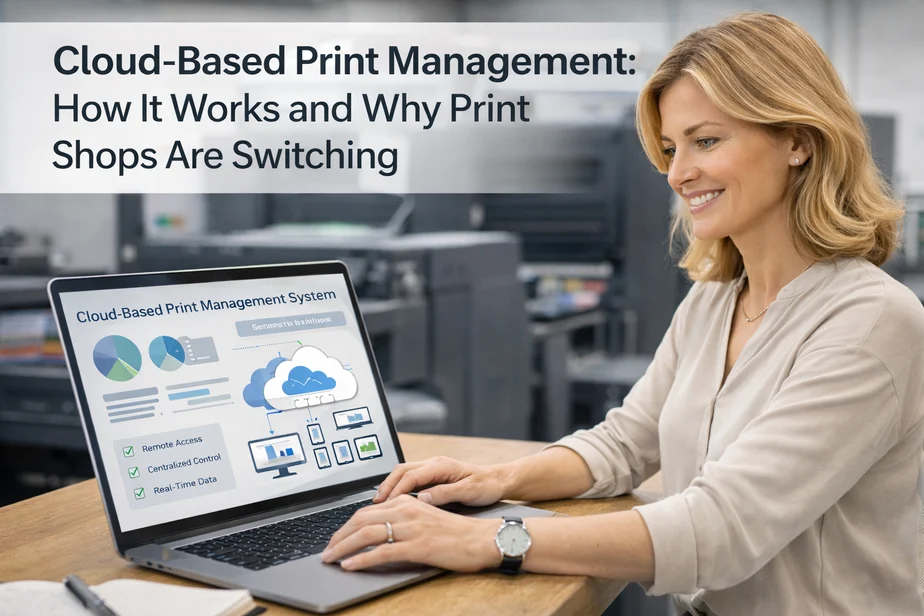
Cloud-based print management runs on the vendor's infrastructure. The PSP accesses it through a browser or mobile app. Updates happen continuously without downtime. Backups are automatic and geographically distributed. Security is handled by the vendor at a scale no individual print shop could match. Pricing is subscription rather than capital expense. The architectural shift from on-premise to cloud is what makes the 2026 operating numbers possible: under 0.35 percent error rate (vs 1.5 percent industry average), 98 percent on-time dispatch (vs 81 percent), 25 to 100 percent revenue growth without proportional headcount, and 10 to 25 percent lower operating costs.
Five operating capabilities cloud-based print management delivers in 2026
1. Real-time visibility and remote access
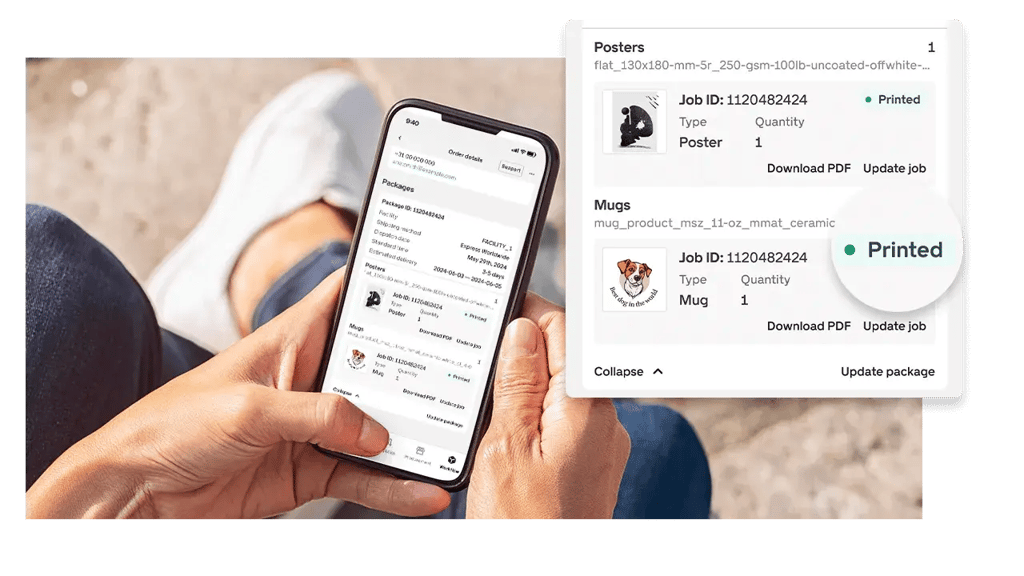
Every layer of the operation reads from and writes to the same record. Production status updates the moment the press finishes the run. Customer-service teams see the same record the production team sees. A salesperson at a customer site can quote a job from live data, not a stale spreadsheet. Bennett Graphics replaced quarterly retrospectives with a real-time KPI dashboard the floor manages by exception, and drove waste from 41 percent to 10 percent on the visibility this architecture enables. Remote access is now a competitive advantage in attracting and retaining skilled staff: estimators, planners, and managers can work flexibly without losing operational control.
2. Continuous AI and feature updates
Cloud platforms ship new capabilities continuously. The AI Estimator on cloud-based print management runs 6 pricing models and 300+ configurable parameters trained on millions of real print transactions, with foundation-model orchestration across Claude, OpenAI, and Gemini through CrewAI and LangChain. Hudson Printing was the first PSP to deploy conversational AI quoting on its public website, hitting a 79 percent close rate (23 of 29 prospects) on sales cycles under one week. ESP Colour produces 200 or more daily estimates at 15 seconds each. None of these capabilities were operating-grade options on an on-premise stack two years ago. They are operating-grade options on cloud-based print management today, with no migration project required to access them.
3. Volume-aggregated procurement and logistics
A cloud platform aggregates volume across its customer base. The PSP gets the network's negotiated rates with carriers (80+ partners) and production partners (150+ across 32 countries) without the network's volume requirement. T-Shirt Gang cut shipping costs by up to 40 percent on this mechanic. ESP Colour saved 17 percent on carrier costs through address validation. TidyMerch reduced procurement effort from 2 hours per day to under 1 minute and recovered 11 percent of volume previously lost to stockouts. The platform's procurement and logistics graphs cannot be replicated on-premise, because the value of the graph is in its scale.
4. Scalability without capital investment
Adding a second production site, a third product line, or a new business unit on an on-premise stack means standing up new infrastructure, hiring new IT support, and waiting weeks for the new capacity to come online. On a cloud platform, the same expansion happens in days. WeMust shipped 20,000 orders in the first month of platform deployment and added a second DTG machine within two weeks of launch on the cloud-based architecture. Imperial Custom Apparel runs 300 product listings per day with 3 people instead of 17 (a 95 percent productivity gain) on a unified cloud record. Oschatz Visuelle Medien GmbH increased capacity by 25 percent without adding headcount on the same pattern.
5. Security, compliance, and disaster recovery at vendor scale
The misconception that on-premise systems are more secure because data lives in the office is dangerous. Large cloud vendors invest at scale in security teams, regular audits, encryption in transit and at rest, and disaster recovery plans no individual print shop could afford. Compliance certifications (SOC 2, GDPR, HIPAA where applicable) are documented and maintained by the vendor. For an on-premise system, compliance is the PSP's responsibility, the PSP's risk, and the PSP's budget. For cloud-based print management, those operating overheads sit with the vendor.
The 30-day cloud migration playbook
- Days 1 to 7: baseline current operating cost and operating overhead. Calculate the all-in cost of the on-premise stack: software licenses, hardware depreciation, IT staff time, integration overhead, and downtime cost. Calculate operating metrics: error rate, on-time dispatch, average quote turnaround, and inventory write-offs. The Imperial Custom Apparel benchmark for software cost reduction is more than $250,000 in licenses removed by consolidating onto a unified cloud platform.
- Days 8 to 14: stand up the unified data spine on the cloud platform. Product catalog, SKU master, supplier graph, customer record, and job ticket all migrate to the cloud record. Shadow-route the next 7 days of orders against the cloud spine while keeping the on-premise stack as the system of record. Confirm the routing decisions match production reality.
- Days 15 to 21: cut over the highest-volume product line. The cloud platform takes over for the dominant product line. The on-premise stack continues for the long tail. Most shops find the day-15 cutover produces immediate gains in visibility and quote turnaround, with the senior estimator role redirecting from queue clearance to account management within the first week.
- Days 22 to 30: validate against baseline and migrate the long tail. Compare error rate, on-time dispatch, quote turnaround, and software cost against the day 1 to 7 baseline. The benchmarks are 0.35 percent error rate, 98 percent on-time dispatch, 95 percent reduction in quoting time, and consolidated software cost. Migrate the long-tail product lines once the dominant line is stable.
Customer outcomes on cloud-based print management
- Hudson Printing: 65 percent quoting effort reduction, first PSP with conversational AI quoting on public website, 79 percent close rate (23 of 29 prospects), under-1-week sales cycle.
- ESP Colour: 95 percent quoting time reduction, doubled profit margin, 7 percent EBIT lift, 14 FTE redeployed to customer-facing work, 17 percent carrier cost savings, 200+ daily estimates at 15 seconds each, 1.7-minute average quote time.
- Imperial Custom Apparel: 300 listings per day with 3 vs 17 people, 95 percent faster, more than $250,000 in software savings.
- TidyMerch: procurement effort 2 hours per day to under 1 minute, 100 percent year-over-year growth, 35 to 40 percent lower warehouse cost per euro of revenue, recovered 11 percent of volume previously lost to stockouts.
- Bennett Graphics: waste 41 percent to 10 percent, packaging and dispatch effort reduced by 80 percent, real-time KPI dashboard.
- WeMust: 20,000 orders shipped in the first month, second DTG machine added within two weeks of launch.
- Oschatz Visuelle Medien GmbH: 25 percent capacity increase without adding headcount.
- T-Shirt Gang: up to 40 percent lower shipping costs.
Where the cloud-based print management pattern caps
Cloud-based print management replaces on-premise stacks for 80 to 95 percent of mid-sized PSP volume that runs on standard commercial print, apparel decoration, and adjacent categories. The remaining 5 to 20 percent (specialty applications, regulated print categories with destructive testing requirements, very small shops where the operating overhead does not pay back, and bespoke specialty processes with single-purpose hardware) may still be served by an on-premise system or a manual workflow. Owners should calibrate which portion of their volume sits inside the cloud pattern and which sits outside it.
The structural answer
Cloud-based print management software is now the standard because it delivers real-time visibility, continuous AI updates, volume-aggregated procurement and logistics, scalability without capital investment, and security at vendor scale. The operating numbers across the GelatoConnect customer base (under 0.35 percent error rate, 98 percent on-time dispatch, 25 to 100 percent revenue growth without headcount, 3 to 7 percentage points of margin improvement, 10 to 25 percent lower op costs) are concentrated in the cohort that ran the migration in 2025 and 2026. PSPs still running on-premise stacks are paying the operating cost on every margin line. The migration is a 30-day project, not a 12-month transformation, and the customer evidence on the outcomes is consistent across geographies and product lines.
Explore GelatoConnect
- GelatoConnect Platform: the cloud-based print management software that runs estimating, procurement, scheduling, and logistics on one record.
- GelatoConnect AI Estimator: the foundation-model orchestration layer that ships continuous updates on the cloud platform.
- GelatoConnect Workflow: the unified production record that replaces on-premise MIS stacks.
- Intelligent operating systems for print production
- Best print production platform for mid-sized manufacturers
- How to replace a legacy print MIS in 2026
- Unified vs best-of-breed print production software
- The print CFO's TCO model for production software
- State of intelligent print production report 2026 (webinar)
- ROI report: GelatoConnect customer outcomes
- See GelatoConnect in action: walk through the platform live with our team.
Frequently asked questions
What is cloud-based print management software in 2026?
Cloud-based print management software runs on the vendor's infrastructure, accessible through a browser or mobile app, with continuous updates, automatic backups, geographically distributed disaster recovery, and security at vendor scale. It replaces on-premise MIS stacks that required dedicated servers, IT staff, and manual upgrades.
What are the five operating capabilities cloud-based print management delivers in 2026?
1) Real-time visibility and remote access (Bennett Graphics waste 41%->10% on this). 2) Continuous AI and feature updates (Hudson Printing 79% close rate on conversational AI quoting). 3) Volume-aggregated procurement and logistics (T-Shirt Gang 40% lower shipping). 4) Scalability without capital investment (WeMust 20K orders first month). 5) Vendor-scale security, compliance, and disaster recovery.
How long does the cloud migration take?
30 days. Days 1-7 baseline current operating cost and overhead. Days 8-14 stand up the unified data spine on cloud. Days 15-21 cut over the highest-volume product line. Days 22-30 validate against baseline and migrate the long tail. Imperial Custom Apparel removed more than $250K in software license costs on this migration.
Is cloud-based print management more secure than on-premise?
Yes for almost all PSPs. Large cloud vendors invest at scale in security teams, regular audits, encryption in transit and at rest, and disaster recovery plans no individual print shop could afford. SOC 2, GDPR, and other compliance certifications are documented and maintained by the vendor. For an on-premise system, compliance is the PSP's responsibility, risk, and budget.
What outcomes do PSPs see on cloud-based print management?
Under 0.35% error rate (vs 1.5% industry average), 98% on-time dispatch (vs 81%), 25-100% revenue growth without headcount, 3-7 pp margin improvement, 10-25% lower op costs. ESP Colour: 95% quoting reduction, doubled margin, 7% EBIT lift. Hudson Printing: 79% close rate, sub-1-week sales cycles. Imperial: $250K+ software savings.
Where does cloud-based print management cap?
Cloud platforms replace on-premise stacks for 80-95% of mid-sized PSP volume. The remaining 5-20% (specialty applications, regulated print categories with destructive testing, very small shops, bespoke specialty processes with single-purpose hardware) may still be served by an on-premise system or a manual workflow.
How do I migrate from on-premise print MIS to cloud-based print management?
Run the 30-day migration playbook: baseline operating cost and overhead, stand up the unified data spine on cloud, cut over the highest-volume product line first, validate against baseline, then migrate the long tail. Most mid-sized PSPs see immediate gains in visibility and quote turnaround within the first week of cutover, with full-stack consolidation by day 30.
Can cloud-based print management handle multiple production sites and remote teams?
Yes, this is one of the structural advantages over on-premise systems. Adding a second production site, a third product line, or a new business unit on a cloud platform happens in days rather than weeks. Remote teams (estimators at customer sites, planners working from home, finance teams across geographies) all read from the same record in real time, with no VPN or middleware required.
Why are print shops switching from on-premise MIS to cloud-based print management in 2026?
Because the operating numbers compound. The on-premise stack carries software licenses, hardware depreciation, IT staff time, integration overhead, and downtime cost on every margin line. The cloud platform aggregates volume across its customer base, ships AI capabilities continuously, scales without capital investment, and produces the platform-level operating numbers (under 0.35 percent error rate, 98 percent on-time dispatch, 25-100 percent revenue growth without proportional headcount). The TCO gap widens every quarter.