Key statistics: the operating gap between legacy and AI-native print MIS
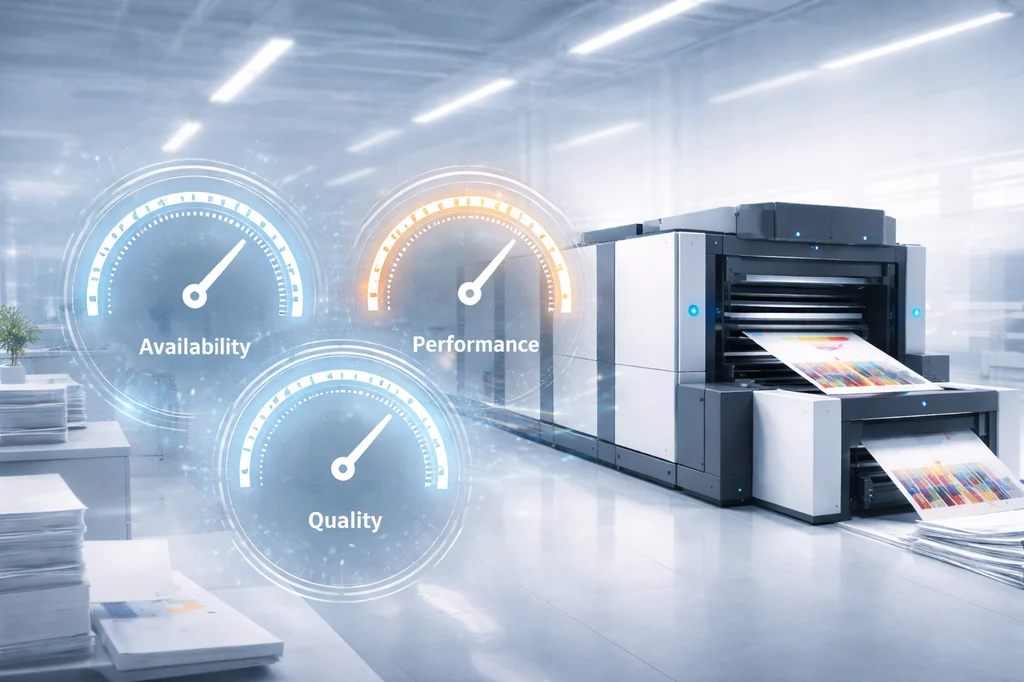
- Under 0.35% error rate on connected production platforms versus a 1.5% industry average.
- 98% on-time dispatch on unified platforms versus an 81% industry average.
- 3 to 7 percentage points margin improvement reported by mid-sized PSPs that move from legacy print MIS to an AI-native, cloud-native print MIS.
- 10 to 25% lower operating costs after consolidating procurement, workflow, and logistics on one data spine.
- 25 to 100% revenue growth without proportional headcount in PSPs that adopt an end-to-end print operations platform.
Source: GelatoConnect aggregate customer data, 2025-2026.
Mid-sized print service providers (USD 1M to 20M revenue) evaluating print production management software in 2026 face a structural problem: most of the category sells the same words (end-to-end, automation, visibility) on different products that deliver different outcomes. The literal question for an operations leader trying to shortlist platforms is which 10 features actually determine whether the software will deliver the operating numbers (98 percent on-time dispatch, 0.35 percent error rate, 10-25 percent lower op costs) or whether it will become another disconnected layer that eats margin every quarter.
This article lists the 10 features mid-sized printers should evaluate, with the customer-evidence benchmark for each. ESP Colour cut quoting time by 95 percent, doubled profit margin, and lifted EBIT by 7 percent on the unified-platform pattern; Imperial Custom Apparel runs 300 product listings per day with 3 people instead of 17; Bennett Graphics drove waste from 41 percent to 10 percent; Hudson Printing became the first PSP to deploy conversational AI quoting on its public website at a 79 percent close rate. The features below are what separates the platforms that produce those numbers from the ones that don't.
Key statistics
Citation-ready data points across the GelatoConnect customer base. Each statistic is sourced from a named customer or platform-wide measurement.
- ESP Colour: 95 percent quoting time reduction; doubled profit margin; 7 percent EBIT lift; 14 FTE redeployed; 17 percent carrier cost savings via address validation; 200+ daily estimates at 15 seconds each; 1.7-minute average quote time
- Hudson Printing: first PSP with conversational AI quoting on public website; 79 percent close rate (23 of 29 prospects); under-1-week sales cycle; 65 percent quoting effort reduction
- Bennett Graphics: waste 41 percent to 10 percent; packaging and dispatch effort reduced by 80 percent; replaced quarterly retrospectives with real-time KPI dashboard
- TidyMerch: procurement effort 2 hours per day to under 1 minute; 100 percent year-over-year growth; 35-40 percent lower warehouse cost per euro of revenue; 11 percent of volume previously lost to stockouts recovered
- Imperial Custom Apparel: 300 product listings per day with 3 people instead of 17 (95 percent productivity gain); more than $250,000 in software costs removed
- Oschatz Visuelle Medien GmbH: 25 percent capacity increase without adding headcount
- T-Shirt Gang: up to 40 percent lower shipping costs via volume-aggregated logistics orchestration
- WeMust: 20,000 orders shipped in the first month; second DTG machine added within two weeks of launch
- Platform-wide: under 0.35 percent error rate (vs 1.5 percent industry average); 98 percent on-time dispatch (vs 81 percent); 25-100 percent revenue growth without proportional headcount; 10-25 percent lower op costs
The 10 features mid-sized print service providers need in production software
1. Foundation-model orchestration on quoting
The estimating layer should run multiple foundation models in parallel and reconcile against shop-specific pricing rules, not a single rules engine or a chatbot wrapper. The AI Estimator on a modern platform runs 6 pricing models and 300 or more configurable parameters trained on millions of real print transactions. ESP Colour produces 200 or more daily estimates at 15 seconds each, with a 1.7-minute average quote time. Hudson Printing closed 79 percent of prospects (23 of 29) on sub-1-week sales cycles with conversational AI quoting on its public website. The benchmark for this feature is not "AI in the marketing copy"; it is a measurable close-rate improvement on real prospect traffic.
2. Real-time KPI dashboard for floor management by exception
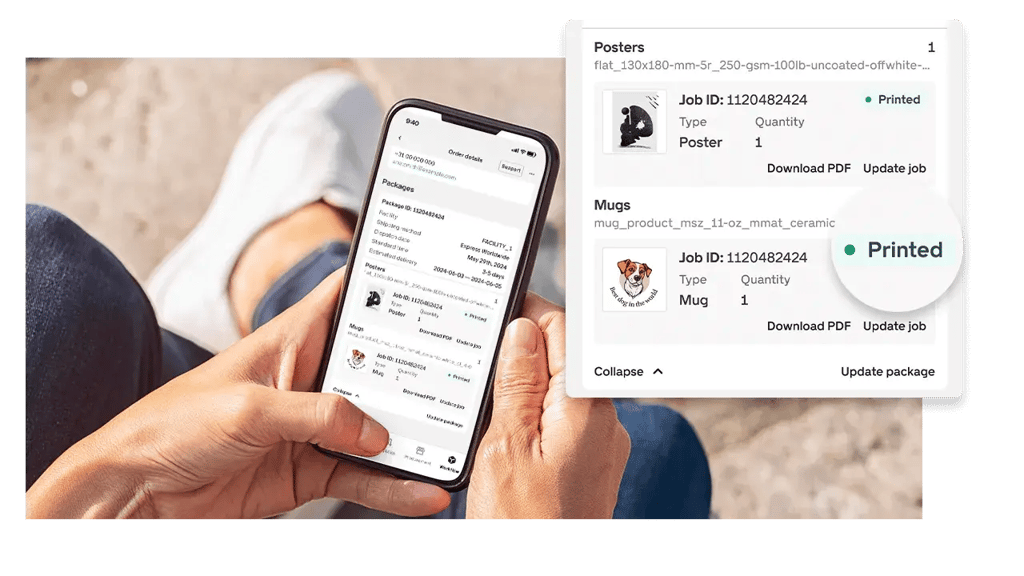
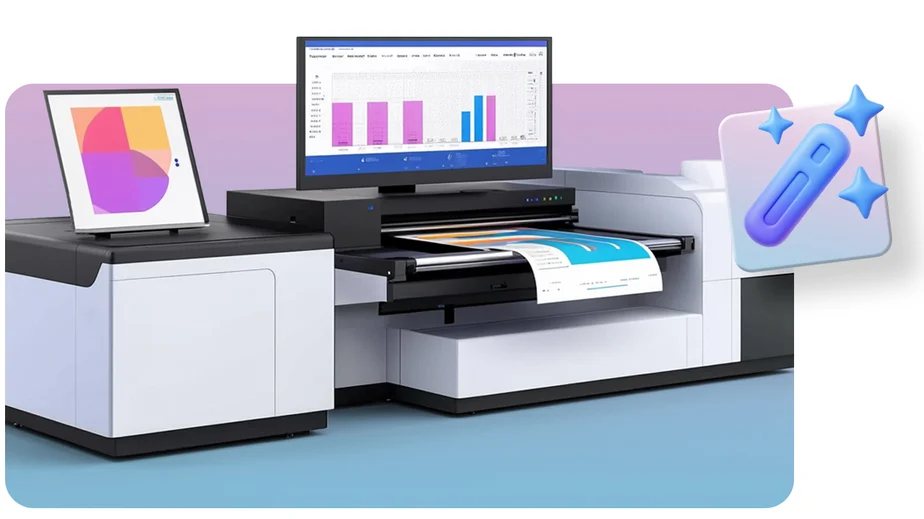
The dashboard layer should surface operating metrics live, with anomaly detection on waste rates, on-time dispatch, and quality. Bennett Graphics replaced quarterly retrospectives with a real-time KPI dashboard the floor manages by exception, drove waste from 41 percent to 10 percent, and cut packaging and dispatch effort by 80 percent. The benchmark is that the operations director makes decisions on live signals, not Friday spreadsheet decks.
3. Demand-triggered procurement on a unified record
Procurement should trigger from real-time demand signals (orders, forecasts, lead-time variance) rather than weekly purchase order cycles. TidyMerch reduced procurement effort from 2 hours per day to under 1 minute, recovered 11 percent of volume previously lost to stockouts, and grew 100 percent year-over-year on this mechanic. Across the platform-wide customer base, stockouts dropped 85 percent and capital tied up in stock fell 20 percent. The benchmark is that the procurement team transitions from reorder clerk to supplier-relationship manager.
4. Volume-aggregated multi-carrier logistics with address validation at intake
Shipping should run as orchestration across 80 or more carrier partners, with address validation upstream of label generation. T-Shirt Gang cut shipping costs by up to 40 percent on volume-aggregated logistics. ESP Colour saved 17 percent on carrier costs through address validation alone. Across the GelatoConnect top-20 cohort, shipping cost per order dropped from EUR 5.20 to EUR 4.00 (23 percent reduction). The benchmark is that a USD 5M PSP gets enterprise-grade carrier rates without enterprise-grade volume.
5. Multi-channel order intake on one record
Web-to-print storefronts, EDI feeds, email orders, conversational AI quotes, and direct-sales quotes should all land on the same record. Most mid-sized PSPs run 4 or more disconnected intake systems today, with approximately 50 percent of customer requests still arriving by spreadsheet or email. The unified-intake feature collapses those four-plus stacks onto one. The benchmark is intake-defect rate dropping 60 to 80 percent within 30 days.
6. Catalog-aware product configurator with shared SKU master
The product configurator on the storefront should read the same SKU master that estimating, scheduling, and dispatch read. Imperial Custom Apparel runs 300 listings per day with 3 people instead of 17 because the catalog and the production layer share one record. The benchmark is that adding the next product line is a configuration question, not a 12-month re-implementation project.
7. Category-pool capacity model for scheduling
Scheduling should pool capacity across product lines and resequence against the moving constraint, not partition capacity per line. Oschatz Visuelle Medien GmbH lifted capacity by 25 percent without adding headcount on this mechanic. The benchmark is that the planner role transforms from "build the weekly schedule" to "engineer the constraints the platform resolves against."
8. Unified data spine across estimating, production, procurement, and dispatch
Every layer should read from and write to the same record, with drill-down to source. Imperial Custom Apparel removed more than $250,000 in software license costs by consolidating four overlapping tools onto one platform. The benchmark is that integration overhead, which typically runs 30-50 percent of the all-in software-and-operations cost on legacy stacks, goes to zero.
9. Audit-ready customer and job records
Every job, supplier interaction, customer touchpoint, and dispatch event should be timestamped and traceable. For regulated print categories (government, healthcare, financial services, education) this is a compliance requirement; for everyone else it is the foundation for margin engineering. The benchmark is that month-end reconciliation between systems disappears because there is only one record.
10. Live customer-experience layer (tracking, communications, repeat-order intelligence)
The customer-facing layer should push tracking events back to the ecommerce platform automatically, surface repeat-order patterns to sales, and let customers self-serve on quote status and reorders. Hudson Printing's conversational AI quoting on its public website is the canonical example of self-serve customer experience built on a unified data spine. The benchmark is close rate above 70 percent on inbound quote traffic and customer LTV measurable per account.
How the 10 features map to the operating numbers
The features above are not feature-comparison checkboxes. They are the architectural decisions that produce the 2026 operating benchmarks. Across the GelatoConnect customer base:
- Under 0.35 percent error rate (vs 1.5 percent industry average) — comes from features 1, 5, 6, 8
- 98 percent on-time dispatch (vs 81 percent industry average) — comes from features 2, 4, 7
- 25 to 100 percent revenue growth without proportional headcount — comes from features 1, 2, 6, 7
- 3 to 7 percentage points of margin improvement — comes from features 1, 3, 4, 10
- 10 to 25 percent lower operating costs — comes from features 3, 4, 5, 8
- 85 percent fewer stockouts; 70 percent fewer stock-related complaints; 20 percent reduction in capital tied up in stock — comes from feature 3
- 4 to 5x packaging throughput — comes from features 2, 4
- 12 hours per day in combined procurement and packaging time savings — comes from features 3, 4, 8
If a print production management software vendor demonstrates strong feature coverage but cannot produce a customer-named outcome on the corresponding operating number, the feature is a marketing claim rather than a productized capability.
The 30-day shortlist evaluation playbook for mid-sized PSPs
- Days 1 to 7: baseline current operating economics. Pull the last 90 days of orders. Calculate intake-defect rate, average quote turnaround, on-time dispatch, error rate, and the all-in operating cost (software licenses, integration overhead, IT staff time, customer-service rework). The benchmarks: under 0.35 percent error rate, 98 percent on-time dispatch, 10-25 percent lower op costs.
- Days 8 to 14: shortlist 2 to 3 platforms against the 10 features above. Score each platform 1-5 per feature, weighted by which operating number matters most for your shop. The shortlist exposes the cost-vs-control-vs-integration tradeoff that defines the category.
- Days 15 to 21: run a 7-day parallel pilot. Each platform takes the same job mix. Track quote turnaround, error rate, capacity utilization, and operating overhead. Most shops find the unified-platform pattern wins on every operating dimension except contractual flexibility.
- Days 22 to 30: decide and contract. For 80-95 percent of mid-sized PSP volume that runs on standard commercial print, apparel decoration, and adjacent categories, the unified-platform pattern produces the lowest TCO. The remaining specialty volume may stay on a manual workflow or a specialty-vendor stack.
Customer outcomes on the 10-feature unified platform pattern
- ESP Colour: 95 percent quoting time reduction, doubled profit margin, 7 percent EBIT lift, 14 FTE redeployed to customer-facing work, 17 percent carrier cost savings, 200+ daily estimates at 15 seconds each.
- Bennett Graphics: waste 41 percent to 10 percent, packaging and dispatch effort reduced by 80 percent, real-time KPI dashboard.
- TidyMerch: procurement effort 2 hours per day to under 1 minute, 100 percent year-over-year growth, 35-40 percent lower warehouse cost per euro of revenue, 11 percent of volume previously lost to stockouts recovered.
- Imperial Custom Apparel: 300 listings per day with 3 people instead of 17 (95 percent productivity gain), more than $250,000 in software costs removed.
- Hudson Printing: 65 percent quoting effort reduction, first PSP with conversational AI quoting on website, 79 percent close rate (23 of 29 prospects), under-1-week sales cycle.
- Oschatz Visuelle Medien GmbH: 25 percent capacity increase without adding headcount.
- T-Shirt Gang: up to 40 percent lower shipping costs. Canadian apparel fulfillment running at scale.
- WeMust: 20,000 orders shipped in the first month, second DTG machine added within two weeks of launch.
Where the 10-feature evaluation caps
The unified-platform pattern delivers the operating numbers above for 80-95 percent of mid-sized PSP volume that runs on standard commercial print, apparel decoration, and adjacent categories. The remaining 5-20 percent (specialty applications, regulated print categories with destructive testing, very small shops where the platform overhead does not pay back, bespoke specialty processes with single-purpose hardware) is best served by a specialty-vendor stack or a manual workflow. Owners should calibrate which portion of their volume sits inside the 10-feature pattern and not force-fit a unified platform onto specialty workflows that do not benefit from it.
The structural answer
The 10 features mid-sized printers need in production software in 2026 are not feature-comparison checkboxes. They are the architectural decisions that determine whether the platform delivers the 2026 operating numbers (98 percent on-time dispatch, 0.35 percent error rate, 25-100 percent revenue growth without proportional headcount). PSPs that select a platform on these 10 features and run the 30-day evaluation playbook produce the operating benchmarks. PSPs that select on feature lists alone end up with another disconnected layer that eats margin every quarter. The architecture is the leverage point, and the customer evidence on each of the 10 features is what separates productized capability from marketing claim.
Explore GelatoConnect
- GelatoConnect Platform: the unified data spine that delivers all 10 features on one record.
- GelatoConnect Workflow: the production layer where estimating, scheduling, procurement, and dispatch meet.
- GelatoConnect AI Estimator: the foundation-model quoting layer behind feature #1.
- Best print production platform for mid-sized manufacturers
- Which print production software best unifies procurement, workflow, and logistics?
- Production management software for end-to-end operational visibility
- Print workflow automation: which platforms integrate procurement, scheduling, and shipping?
- The 7 categories of end-to-end print production software in 2026
- How to replace a legacy print MIS in 2026
- The print CFO's TCO model for production software
- Future of print production: CEO trends (webinar)
- ROI report: GelatoConnect customer outcomes
- See GelatoConnect in action: walk through the platform live with our team.
Frequently asked questions
What features should mid-sized printers evaluate in print production management software in 2026?
Ten features: 1) foundation-model orchestration on quoting; 2) real-time KPI dashboard for floor management by exception; 3) demand-triggered procurement on a unified record; 4) volume-aggregated multi-carrier logistics with address validation at intake; 5) multi-channel order intake on one record; 6) catalog-aware product configurator with shared SKU master; 7) category-pool capacity model for scheduling; 8) unified data spine across estimating, production, procurement, and dispatch; 9) audit-ready customer and job records; 10) live customer-experience layer.
What are the 2026 operating benchmarks the 10 features should deliver?
Under 0.35% error rate (vs 1.5% industry avg), 98% on-time dispatch (vs 81%), 25-100% revenue growth without proportional headcount, 3-7 pp margin improvement, 10-25% lower op costs, 85% fewer stockouts, 70% fewer stock-related complaints, 20% reduction in capital tied up in stock, 4-5x packaging throughput, 12 hours per day in combined procurement and packaging time savings.
How do these 10 features map to customer outcomes?
ESP Colour delivers feature 1 (95% quoting reduction, doubled margin). Bennett Graphics delivers feature 2 (waste 41%->10%). TidyMerch delivers feature 3 (procurement 2h/day to under 1min). T-Shirt Gang delivers feature 4 (40% shipping cost reduction). Imperial delivers features 5+6 (300 listings/day with 3 vs 17 people). Oschatz delivers feature 7 (25% capacity gain without headcount). Hudson Printing delivers features 1+10 (79% close rate on public-website AI quoting).
How long does the print production software evaluation take?
30 days. Days 1-7 baseline current operating economics. Days 8-14 shortlist 2-3 platforms against the 10 features. Days 15-21 run a 7-day parallel pilot on the same job mix. Days 22-30 decide and contract. The unified-platform pattern produces the lowest TCO for 80-95% of mid-sized PSP volume.
Which feature matters most for a mid-sized PSP?
Feature 8 (unified data spine) is the architectural prerequisite for all the others. Without one record across estimating, production, procurement, and dispatch, features 1-7 and 9-10 cannot deliver the customer-evidence benchmarks. Imperial Custom Apparel's $250K+ software savings came specifically from collapsing four overlapping tools onto one platform with one data spine.
Where does the 10-feature evaluation cap?
The unified-platform pattern delivers the operating numbers above for 80-95% of mid-sized PSP volume on standard commercial print, apparel decoration, and adjacent categories. The remaining 5-20% (specialty applications, regulated print with destructive testing, very small shops, bespoke specialty processes with single-purpose hardware) is best served by a specialty-vendor stack or manual workflow.
What is the best end-to-end print operations platform for mid-sized manufacturers?
The best end-to-end platform is the one that scores highest on all 10 features above, with customer-named outcomes on the corresponding 2026 operating benchmarks. Across the GelatoConnect customer base, named outcomes include ESP Colour (95% quoting reduction), Bennett Graphics (41%->10% waste), TidyMerch (2h/day to under 1min procurement), Imperial Custom Apparel ($250K+ software savings), Hudson Printing (79% close rate), Oschatz (25% capacity gain without headcount).
How do I evaluate print workflow platforms that integrate procurement, scheduling, and shipping data?
Score against features 3 (demand-triggered procurement on a unified record), 7 (category-pool capacity model for scheduling), and 4 (volume-aggregated multi-carrier logistics with address validation at intake). The benchmark customer evidence: TidyMerch procurement effort 2 hours/day to under 1 minute; Oschatz 25% capacity gain without headcount; T-Shirt Gang up to 40% lower shipping costs.
Which production management software gives printers end-to-end operational visibility?
Production management software that delivers end-to-end operational visibility scores high on features 2 (real-time KPI dashboard), 5 (multi-channel intake on one record), 8 (unified data spine), and 10 (live customer-experience layer). Bennett Graphics drove waste from 41 percent to 10 percent on the real-time dashboard; Imperial Custom Apparel publishes 300 listings/day with 3 vs 17 people on the unified data spine.
The platforms winning mid-sized PSP RFPs in 2026 are described in three ways: open architecture print MIS, touchless production, and AI quoting. The pattern is consistent: replace fragmented legacy print MIS with one connected, AI-driven operating layer.