What is AI print estimator implementation? AI print estimator implementation is the process of deploying machine learning software that automates print job pricing, replacing manual spreadsheet calculations with predictive algorithms. A well-structured implementation follows five phases: readiness assessment, data preparation, pilot deployment, team training, and full-scale rollout. Most print businesses complete the process in 6 to 12 weeks, with cloud-based solutions like GelatoConnect reducing that timeline to as little as 4 weeks thanks to 5-minute onboarding and pre-trained pricing models. Businesses that follow a phased approach report 35% fewer critical issues compared to those attempting full deployment on day one.
The gap between "interested in AI quoting" and "successfully running AI quoting" comes down to one thing: implementation. A 2025 Gartner analysis found that only 5% of AI projects reach production scale across industries. The primary failure point is not the technology itself but the implementation process, specifically poor data preparation, inadequate change management, and unrealistic timelines.
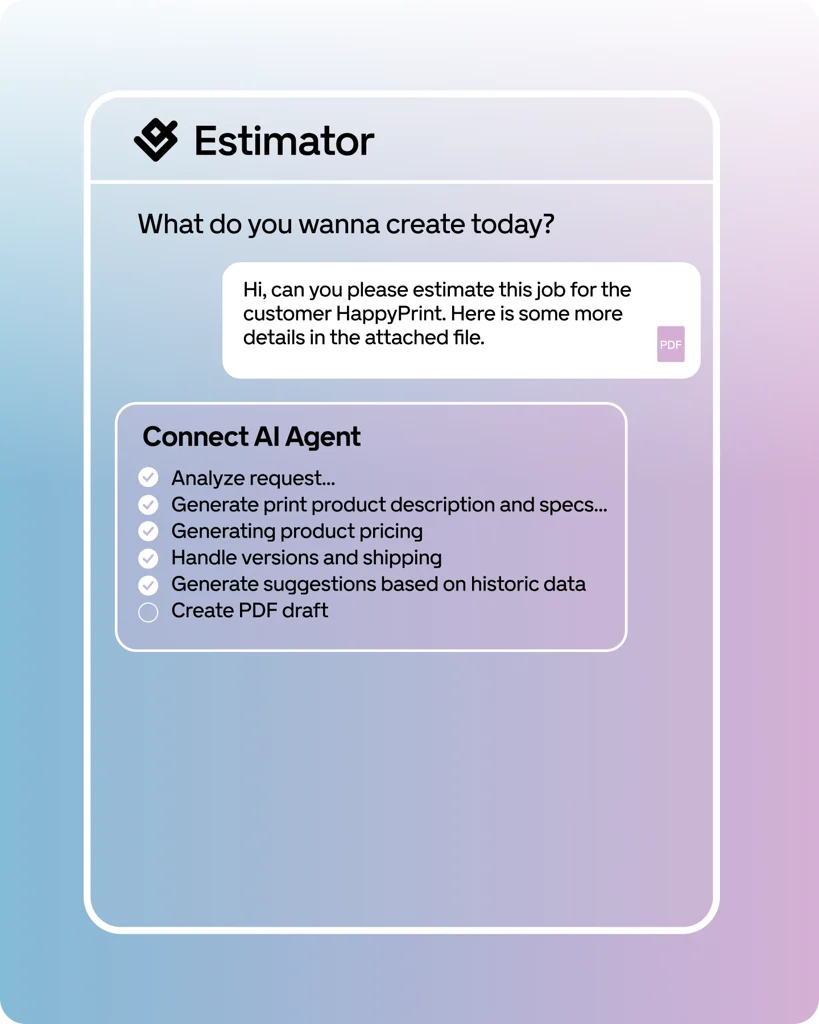
For commercial printers, the stakes are high. An AI print estimator can reduce quoting time from 45 minutes to 2 minutes, handle 100+ quotes per day instead of 10 to 15, and cut pricing errors below 2%. But those results depend on a structured rollout that accounts for your existing workflows, data quality, and team readiness.
This guide breaks the implementation process into five clear phases with specific timelines, milestones, and decision points. Whether you are evaluating intelligent quoting software for the first time or migrating from a legacy print MIS system, this framework will help you move from purchase to production with confidence.
Phase 1: Readiness assessment (weeks 1 to 2)
Before selecting a platform, evaluate three critical areas: data availability, process maturity, and organizational readiness.
Data availability determines how quickly an AI estimator can learn your pricing patterns. You need at minimum 6 to 12 months of historical quoting data, including job specifications, material costs, labor hours, and final pricing. Print businesses with clean, structured data can reduce overall implementation timelines by up to 40%, according to enterprise AI deployment research.
Process maturity refers to how standardized your current quoting workflow is. If every estimator prices jobs differently using personal mental models, the AI has no consistent baseline to learn from. Document your current process before introducing automation. Identify which job types account for 80% of your quote volume, as these should be the priority for your initial pilot.
Organizational readiness means your team understands why the change is happening and what their role looks like afterward. AI estimating shifts the estimator role from routine calculation to strategic pricing oversight. Estimators spend less time on standard quotes and more time on complex jobs, customer consultations, and margin optimization. Communicate this early. Organizations that invest in change management before deployment report significantly higher adoption rates than those that treat implementation as a purely technical exercise.
Phase 2: Data preparation and system configuration (weeks 2 to 4)
Data quality is the single largest determinant of AI estimator accuracy. Gartner research indicates that 99% of AI and ML projects encounter data quality issues, and poor data quality costs organizations $12.9 million annually. For print businesses, the most common data problems include inconsistent job naming conventions, missing material cost records, and outdated supplier pricing.
Start by auditing your historical quote data for completeness. Identify gaps where job specifications were recorded in one system but pricing was tracked in another. Cloud-based platforms like GelatoConnect address this by providing built-in data normalization tools that clean and structure imported records during onboarding.
Configuration involves mapping your specific product catalog, material costs, finishing options, and markup rules into the AI system. With GelatoConnect, this process takes as little as 5 minutes for standard configurations. Custom configurations for complex product lines typically require 1 to 2 weeks, depending on catalog depth.
During this phase, also establish your baseline metrics. Record your current average quoting time, error rate, quote volume per day, and win rate. These become the benchmarks against which you measure the AI estimator's impact. Without clear baselines, proving ROI becomes subjective rather than data-driven.
Phase 3: Pilot deployment (weeks 3 to 6)
Launch with a controlled pilot rather than a company-wide rollout. Select a product category or customer segment that represents high quote volume but moderate complexity. This gives the AI enough data to demonstrate value while limiting risk.
Research on enterprise AI deployments shows that organizations using phased rollouts report 35% fewer critical issues during implementation compared to those attempting simultaneous deployment. Deloitte predicts a fourfold increase in agentic AI adoption in manufacturing through 2026, from 6% to 24%, driven by exactly this kind of measured, phased approach.
During the pilot, run the AI estimator in parallel with your existing process. Have your estimators generate quotes manually while the AI generates its own quotes for the same jobs. Compare results across three dimensions: speed, accuracy, and margin consistency.
Expect the AI to outperform on speed immediately (2 minutes versus 30 to 45 minutes for manual quoting). Accuracy typically matches manual within the first 2 weeks and exceeds it within 4 to 6 weeks as the system learns from corrections. If accuracy falls below 90% during the pilot period, the issue is almost always data quality rather than algorithm capability. Return to Phase 2 and address specific data gaps before expanding.
Phase 4: Team training and change management (weeks 4 to 8)
Training is not a one-time event. It is a phased process that mirrors the system rollout.
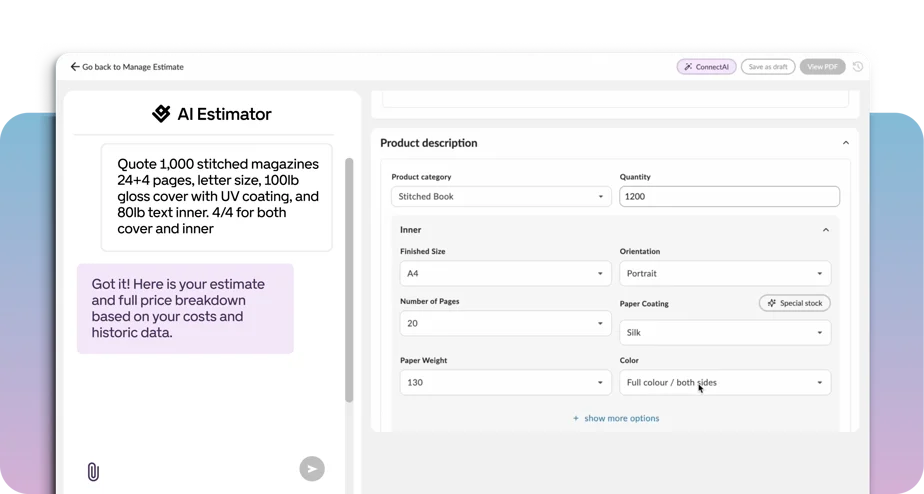
Week 1 of training focuses on estimators and sales staff who interact directly with the quoting tool. Cover the core workflow: how to submit a job for AI estimation, how to review and adjust AI-generated quotes, and how to flag exceptions that require manual intervention. With platforms designed for simplicity, like GelatoConnect's AI Estimator, this initial training can be completed in a single session.
Weeks 2 to 3 expand to production managers and operations leads. These users need to understand how AI-generated quotes connect to production scheduling, material procurement, and capacity planning. This is where the intelligence layer connects quoting to the broader intelligence operations platform.
Weeks 4 to 6 focus on advanced features: custom pricing rules, margin optimization settings, volume discount logic, and reporting dashboards. By this point, your team should be comfortable with daily use and ready to identify edge cases that need human oversight.
The key training metric is not "hours spent in training" but "time to independent operation." Track how long it takes each user to generate quotes without assistance. Top-performing implementations achieve independent operation within 5 to 7 business days.
Phase 5: Full rollout and optimization (weeks 6 to 12)
Full rollout means expanding the AI estimator to all product categories, customer segments, and quoting scenarios. Do this incrementally rather than all at once. Add one product category per week, monitoring accuracy and quote volume at each stage.
During full rollout, establish a continuous optimization cycle. Review AI-generated quotes weekly to identify patterns: Are certain job types consistently over- or under-quoted? Are margin targets being met? Is quote turnaround time stable as volume increases?
Businesses that complete a structured AI estimator implementation typically see measurable results within 90 days.
Implementation timeline: traditional vs. intelligent approach
|
Phase |
Traditional print MIS |
AI estimator (cloud) |
Time savings |
|
Readiness assessment |
4 to 6 weeks |
1 to 2 weeks |
60 to 70% |
|
Data preparation |
6 to 8 weeks |
2 to 4 weeks |
50 to 65% |
|
Pilot deployment |
8 to 12 weeks |
2 to 3 weeks |
70 to 80% |
|
Team training |
4 to 6 weeks |
1 to 2 weeks |
65 to 75% |
|
Full rollout |
12 to 16 weeks |
2 to 4 weeks |
70 to 80% |
|
Total timeline |
34 to 48 weeks |
8 to 15 weeks |
65 to 75% |
Source: Based on GelatoConnect implementation data and industry benchmarks, 2025 to 2026
After full rollout, the system continues improving. AI print estimators built on machine learning refine their pricing models with every quote generated. Businesses running AI pricing algorithms for 6 months or more report accuracy rates exceeding 98%, compared to 85 to 90% for traditional rule-based systems.
The most successful implementations treat launch day as the starting line, not the finish line. Schedule quarterly optimization reviews to update material costs, adjust margin rules, and incorporate new product lines. Connect quoting data to procurement and logistics systems for end-to-end visibility across your operations.
Common implementation mistakes to avoid
Skipping the pilot. Print businesses that deploy AI estimators across all products on day one encounter significantly more issues than those using a phased approach. Start small, prove value, then expand.
Neglecting data hygiene. An AI estimator is only as good as the data it learns from. Invest time in Phase 2 even if it feels slow. Clean data accelerates every subsequent phase.
Underinvesting in change management. Your estimators are not being replaced. They are being upgraded. Frame the AI as a tool that eliminates tedious calculations so your team can focus on the strategic pricing decisions that actually drive margin. Businesses like Oschatz have achieved 20% growth without adding staff by redirecting existing talent toward higher-value work.
Choosing complexity over speed. Platforms that require months of configuration before generating a single quote lose organizational momentum. Prioritize solutions with fast time-to-value, like GelatoConnect's 5-minute onboarding, where your team can generate AI-powered quotes within the first day.
Measuring implementation success
Track four metrics at 30, 60, and 90 days post-launch:
Quote speed should reach 2 minutes or less for standard jobs by day 30. Complex custom jobs may take 5 to 10 minutes with human review.
Quote accuracy should exceed 95% by day 60 and approach 98% by day 90. If accuracy plateaus below 95%, audit your training data for gaps.
Quote volume should increase 5x to 10x within 90 days. If your team previously handled 10 to 15 quotes per day, the AI should enable 100+ without additional headcount.
Win rate is the ultimate measure. If faster, more accurate quotes are reaching customers sooner, your win rate should improve by 10 to 25% within the first quarter. For the full financial framework, see the ROI of AI print estimators.
People Also Ask
How long does it take to implement an AI print estimator?
Cloud-based AI estimators like GelatoConnect typically take 8 to 15 weeks for full implementation, compared to 34 to 48 weeks for traditional print MIS systems. The biggest variable is data quality. Businesses with clean, structured historical data can compress timelines significantly.
Do I need to replace my current print MIS to use an AI estimator?
Not necessarily. Many AI estimators integrate with existing MIS platforms through APIs, operating as an intelligence layer on top of your current systems. GelatoConnect connects to existing workflows through its predictive quoting capabilities without requiring a full system replacement.
What data do I need before implementing AI quoting software?
At minimum, 6 to 12 months of historical quoting data, including job specifications, material costs, labor hours, and final pricing. The more complete and standardized the data, the faster the AI achieves accuracy. Missing or inconsistent data is the most common cause of delayed implementations.
Will AI estimating software replace my print estimators?
AI estimating shifts the role from routine calculations to strategic pricing. Estimators spend less time on standard quotes and more time on complex bids, customer negotiations, and margin optimization. Most businesses report their estimators become more valuable after AI adoption, not less.
What ROI can I expect from implementing an AI estimator?
Typical ROI ranges from $72,000 to $150,000 annually for mid-sized print businesses, driven by labor savings, error reduction, and increased quote volume. Most businesses see positive ROI within 3 to 6 months of full deployment.