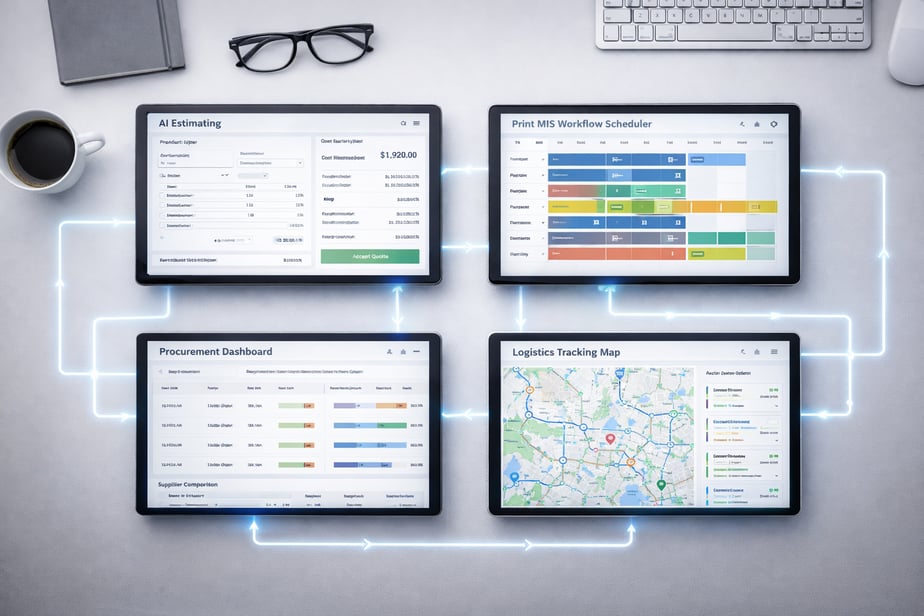
The software running your print shop's management functions has more influence over your profitability than most businesses realize. It shapes how quickly you can quote, how accurately you schedule, how efficiently you purchase materials, and how reliably you fulfill. Two categories of print shop management software exist today, and the gap between them is widening.
Traditional print shop management software was built to organize. Intelligence-powered platforms are built to optimize. Understanding the difference matters for any print business making decisions about operational technology in the next twelve months.
What traditional print shop management software delivers
Traditional print shop management software, often referred to as print MIS, brought meaningful improvement to print operations when it was introduced. It replaced paper-based job tracking with digital records, gave managers visibility into job status across the shop floor, and enabled basic cost tracking against jobs.
The core value proposition was organization and record-keeping. Jobs could be tracked from order to delivery. Materials could be associated with specific jobs. Invoicing could be generated from job records. For businesses that had previously managed all of this on paper or in spreadsheets, the step up was significant.
Traditional systems are characterized by structured data entry, manual pricing tables, and rules-based workflow routing. They capture information efficiently but generate limited analytical insight from that information. Decisions are still made by people drawing on their experience. The software provides records; it does not provide recommendations.
The limitations that emerge at scale
The limitations of traditional print shop management software become most visible when businesses grow. As order volume increases, the demands on the system multiply faster than the system can adapt.
Manual pricing tables require constant maintenance. Every time a material cost changes, a staff member must update the table. During periods of supply chain volatility, this becomes a full-time task. Quotes generated against outdated pricing erode margin in ways that are difficult to catch in real time.
Rules-based scheduling works when jobs follow predictable patterns. It struggles with variability. When a large job runs overtime, when equipment goes down unexpectedly, or when a rush order requires reprioritization, traditional scheduling systems require manual intervention. Each intervention consumes management time and creates ripple effects through the production queue.
Reporting in traditional systems is typically backwards-looking. You can see what happened. You cannot see what is likely to happen next or receive recommendations on how to improve outcomes. The gap between data and decision remains, filled by human judgment operating without systematic support.
The State of Intelligent Print Production 2026
Benchmarks, trends and AI strategies from the world's leading print operations — see what's driving growth in 2026.
Download the report →What intelligence-powered platforms do differently
Intelligence-powered print shop management platforms are architecturally different from traditional systems. They are built around connected data flows, machine learning models, and automated decision-making at routine operational points.
The most important difference is live data integration. Rather than relying on manually updated tables, intelligence-powered platforms connect directly to supplier pricing feeds, carrier rate APIs, and market data sources. Every calculation, from estimating to procurement to shipping cost, draws on current information. Margin is protected automatically as conditions change.
Scheduling in intelligence-powered platforms uses predictive models rather than rules. The system analyzes current capacity, job requirements, equipment performance history, and deadline constraints to generate optimized schedules that adapt dynamically as conditions change. When a job runs over schedule, the system recalculates the entire production queue and surfaces the highest-priority adjustments for management review.
Estimating becomes a model-driven function rather than an expertise-driven one. AI estimators apply consistent pricing logic to every job, learn from historical actual-versus-estimated variance, and improve accuracy over time without manual calibration.
The operational outcomes that separate them
The differences in architecture produce measurable differences in outcomes. GelatoConnect customers operating on the intelligence-powered platform achieve a dispatch-on-time rate of 98% and a production error rate below 0.35%. Businesses on traditional systems typically report significantly higher error rates and more variable on-time performance.
Oschatz grew production output by 20% without adding staff after implementing intelligent operations management. The capacity gain came from eliminating manual bottlenecks and improving scheduling accuracy, not from adding resources.
Bennett Graphics reduced material waste from 41% to 10%, a 75% reduction in waste, by connecting procurement intelligence with production data. Traditional systems could track the waste; they could not systematically prevent it.
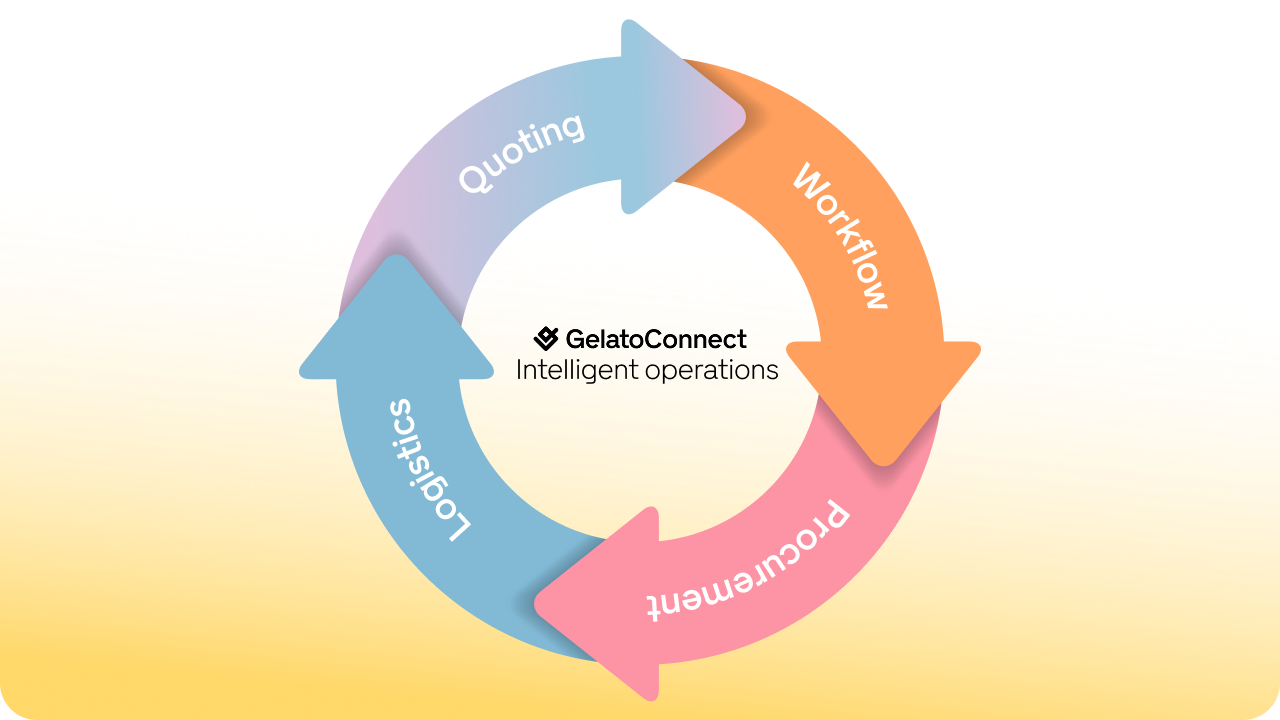
These outcomes reflect the compound effect of improvements across multiple operational dimensions simultaneously. Intelligence-powered platforms optimize estimating, scheduling, procurement, and logistics in an integrated system rather than improving each function in isolation. For more on what this looks like end to end, see our guide on building the complete print automation platform.
Evaluating the transition
The decision to move from traditional to intelligence-powered print shop management software is significant but manageable for businesses that approach it systematically.
The starting point is an honest assessment of where your current system is creating friction. Common friction points include estimating that takes too long or produces inconsistent margins, scheduling that requires significant manual adjustment, procurement that generates too many emergency orders, and reporting that cannot answer the questions your management team needs answered.
Each friction point has a quantifiable cost. Estimating that takes 24 hours per quote has a cost in lost jobs. Emergency procurement orders have a cost in purchasing premiums. Production errors have a cost in rework and customer relationships. Summing these costs builds the business case for the transition investment. You can also explore our ROI report for benchmark data.
GelatoConnect's intelligence-powered platform is designed for print businesses generating between $1M and $50M in annual revenue. It integrates procurement, workflow, and logistics intelligence into a single system with structured onboarding that delivers operational results within weeks, not months. Book a demo to see how the platform performs against your specific workflow and operational requirements.