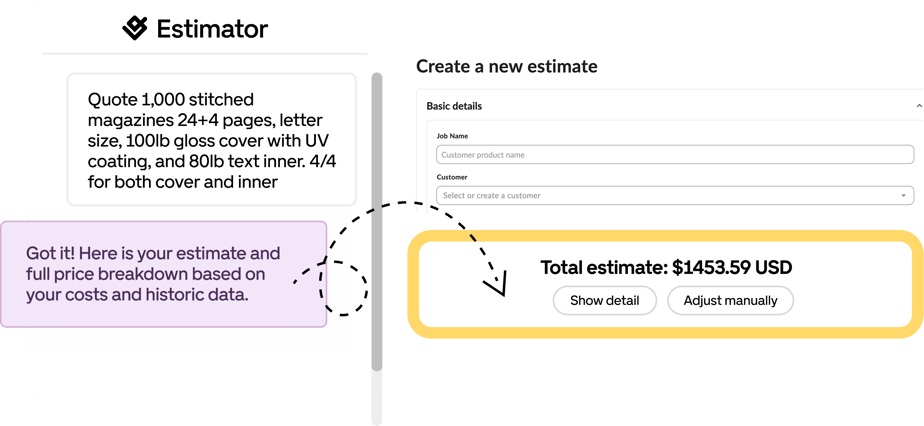
The 20-second quote that's redefining apparel decoration
At Ink n Art, a 14-product apparel quote that used to take a senior estimator one and a half to two hours now closes in 20 seconds on the AI Estimator. The shop projects annual savings of 500,000 to 700,000 EUR from the workflow change alone, with 30 percent revenue growth coming from the sales capacity that quoting used to consume. That single data point reframes the question every apparel decoration owner is now asking: how does AI quoting software for apparel decorators actually work, where does it deliver the biggest margin lift, and what does the math look like for a 1M to 20M USD decoration shop?
This article walks through the answer, starting with why apparel decoration is the hardest category in print to quote manually, what AI quoting changes for DTG, DTF, embroidery, sublimation, and screen print, and the 30-day rollout most shops follow to get there.
Why apparel decoration is the worst category for manual quoting
Decoration quoting is configurator-heavy. A single job depends on garment style, color, size run, decoration method, location count, ink count, stitch count, fabric blend, blank cost, decoration setup, and freight. Every variable changes the price, and most shops have one or two senior estimators who hold the costing logic in their heads or in a 50-tab spreadsheet. The result is one to two hours per quote, inconsistent margins across estimators, and a sales team that loses deals to faster competitors. A spreadsheet quoting workflow or a rule-based estimator built ten years ago cannot keep up with the variable count, and a legacy decoration MIS rarely supports the mixed-method jobs decorators actually win.
What AI quoting software for apparel decorators actually does
Configurator-aware estimation
The AI Estimator is trained on millions of real print transactions, with decoration-specific variables built into the costing engine. It runs six pricing models and exposes more than 300 configurable parameters, so a decoration shop can match its own costing logic without building or maintaining a spreadsheet model. Garment library, decoration setup costs, ink coverage assumptions, stitch-count rates, and blank pricing all sit in one engine. The estimator handles the configurator complexity that breaks legacy decoration MIS, and it does it without forcing the shop to throw away its pricing logic. The decorator stops being the bottleneck on quote turnaround, because the engine already knows how decoration cost actually behaves.
Quote in seconds, not hours
Speed is the headline number. Ink n Art completes 14-product apparel quotes in 20 seconds, against the one and a half to two hours those same quotes used to take a senior estimator. Hudson Printing cut quoting effort by 65 percent across its commercial print and apparel mix. ESP Colour now produces more than 200 daily estimates at 15 seconds each on the AI Estimator, with a 1.7-minute average across job types once the more complex jobs are included. These are not pilot numbers. They are production workloads at shops competing for the same accounts apparel decorators are quoting today.
Margin discipline at scale
The estimator enforces costing rules consistently across every quote and every estimator. ESP Colour doubled profit margin and lifted EBIT 7 percent without raising sticker prices, because every quote stopped leaving margin on the table. The variability that comes from a junior estimator pricing a job differently than a senior estimator simply disappears. For a decoration shop running multiple sales reps, that consistency is the difference between protected margin and quote-by-quote leakage. The AI Estimator is the control layer the shop owner has been trying to build with spreadsheets for years.
Sales capacity unlock
The bigger lift is what happens to the senior estimator's day. ESP Colour recovered 14 full-time roles from manual workflow and reinvested those people in customer-facing work. Ink n Art projects 30 percent revenue growth, not from new sales hires, but from the estimating capacity the AI Estimator gave back to the team. The math is simple. When a shop frees one senior estimator from 30 hours a week of manual quoting, that estimator becomes a strategic account manager. The sales team grows without growing headcount.
Conversational AI on the public website
Hudson Printing became the first PSP to deploy conversational AI quoting on its public website, allowing prospects to self-serve a quote in real time. The AI Estimator close rate sits at 79 percent (23 of 29 prospects in early deployment), with a sales cycle under one week. For an apparel decorator competing against shops with two-day quote turnaround, the public-website quote is a category shift. Prospects who used to fill in a contact form and wait now leave with a price.
Where AI quoting changes apparel decoration economics
DTG and DTF
Per-print cost on DTG and DTF depends on garment color, ink coverage, and substrate. A black tee with full-coverage artwork carries different ink cost than a white tee with a small chest print, and the spreadsheet flat-rate model loses money on the heavy jobs and overprices the light ones. AI estimating reads the artwork file and the garment selection, then prices ink coverage in real time. The decorator stops carrying the risk of mis-priced color jobs, and the customer gets a quote that reflects the real cost. Automated screen print quoting and DTG quoting both benefit from the same engine, because the underlying costing logic is shared.
Embroidery
Stitch-count estimation has traditionally required the artwork to be digitized first, which adds a half-day delay to every embroidery quote. AI estimating produces a defensible price before digitizing, based on the artwork file and the decoration size. The shop can quote, win the job, and digitize in production rather than during the sales cycle. For a decoration shop that quotes embroidery as a secondary service, that change alone collapses the quote-to-cash window from days to hours.
Screen print
Setup cost dominates short-run screen print, and the breakeven point shifts with ink count, location count, and run size. AI estimating surfaces the run size that makes a job profitable, rather than leaving that math to a salesperson eyeballing a spreadsheet. The shop owner gets visibility into which short runs are worth taking and which ones are losing money on setup. Automated screen print quoting becomes a margin-protection tool, not just a speed tool.
Mixed-method jobs
Decoration jobs frequently combine methods: DTG plus embroidery, DTF plus heat-transfer, screen print plus a sublimated label. Pricing those jobs in a spreadsheet means stitching together three or four cost models and hoping the salesperson catches every variable. AI estimating is the only practical way to price mixed-method jobs consistently across a sales team. For decoration shops that compete on the high-mix accounts, that consistency is the competitive moat.
The 30-day rollout playbook
- Days 1 to 7. Baseline the manual workflow. Pull the last 100 quotes. Bucket them by decoration method. Time the manual quote process for each bucket. Measure win rate by bucket. This is the baseline against which every later number is compared.
- Days 8 to 14. Configure the AI Estimator. Load the shop's pricing rules, garment library, and decoration cost model into the estimator. Most decoration shops complete this in days, not weeks, because the engine already knows the underlying physics of decoration cost. The shop is configuring its own logic, not building from scratch.
- Days 15 to 21. Shadow-quote against the same 100 jobs. Compare the AI Estimator quote to the original manual quote on price, margin, and turnaround. Where the AI price diverges from the manual price, ask whether the rule needs tuning or whether the manual quote was the one leaving margin on the table. Most divergence falls into the second bucket.
- Days 22 to 30. Switch sales over. Track win rate, average quote time, margin per quote, and quote volume per estimator against the baseline. Most decoration shops see 80 to 95 percent quoting time reduction in the first month, with margin holding flat or improving.
The economics, run for a real shop
Take a 5M USD decoration shop quoting 30 jobs per day at 45 minutes per quote. That is roughly 22.5 hours per day on quoting, spread across multiple estimators working in parallel. At 50 USD per hour loaded, that is 1,125 USD per day, or 280,000 USD per year, just on the act of producing quotes. AI quoting at 15 to 60 seconds per quote collapses that workload to under 30 minutes per day across the entire team. The freed capacity does not get laid off. It gets redirected to account growth, customer onboarding, and the consultative work that decorators close deals on. That is where the 30 percent revenue growth Ink n Art is projecting comes from.
Customer outcomes
The proof points are concrete and quantified across decoration and commercial print:
- Ink n Art. 14-product quotes in 20 seconds versus one and a half to two hours manually. 500,000 to 700,000 EUR projected annual savings. 30 percent revenue growth projection from freed sales capacity.
- BSG. Featured AI Estimator customer running the platform to scale apparel decoration quoting.
- Hudson Printing. 65 percent quoting effort reduction. First PSP with conversational AI quoting on its public website. 79 percent close rate (23 of 29 prospects). Sales cycle under one week.
- ESP Colour. 95 percent quoting time reduction. Doubled profit margin. 7 percent EBIT lift. 14 FTE saved in workflow. More than 200 daily estimates at 15 seconds each. 1.7-minute average quote time.
Across the GelatoConnect platform, error rates run under 0.35 percent (versus a print industry baseline near 1.5 percent), and on-time dispatch sits at 98 percent (versus an industry baseline near 81 percent). Customers report 25 to 100 percent revenue growth without proportional headcount. The AI Estimator is the fastest-adopted product in Gelato history.
Why AI quoting is now table stakes for apparel decorators
Apparel decoration is the print category with the most quoting variables and the smallest senior-estimator pool. The shops winning the next decade of apparel work are the ones quoting in seconds against shops still quoting in hours. AI quoting software for apparel decorators, paired with AI estimating across DTG, DTF, embroidery, sublimation, and screen print, is no longer an optimization. It is the only architecture that lets a 1M to 20M USD decoration shop quote at the speed today's customers expect, with the margin discipline the owner needs, and without burning out the senior estimators who hold the shop together. The decoration shops moving first are the ones setting the price the rest of the market will have to match.
Explore GelatoConnect
- GelatoConnect AI Estimator: 6 pricing models, 300+ configurable parameters, trained on millions of real print transactions.
- GelatoConnect Apparel: the apparel decoration use case on a unified platform, with native quoting, production, and logistics.
- GelatoConnect Workflow: the production-side platform that holds the AI estimate, the job ticket, and the dispatch on one record.
- AI Estimator with Ink n Art (webinar)
- BSG and the AI Estimator (webinar)
- How to scale an apparel decoration business without adding headcount
- AI in commercial printing: the 2026 definitive guide
- Intelligent operating systems for print production
- See GelatoConnect in action: walk through the platform live with our team.
Frequently asked questions
How does AI quoting software for apparel decorators actually work?
The AI Estimator is trained on millions of real print transactions, with decoration-specific variables built into the costing engine. It runs six pricing models and exposes more than 300 configurable parameters. A decoration shop loads its garment library, decoration setup costs, ink coverage assumptions, stitch-count rates, and blank pricing into one engine. Quotes generate in seconds based on the artwork file, garment selection, and decoration method, with consistent margin discipline across every estimator.
How fast can an apparel decorator quote with AI quoting software?
Ink n Art completes 14-product apparel quotes in 20 seconds, against 1.5 to 2 hours manually. Hudson Printing cut quoting effort by 65 percent. ESP Colour now produces 200+ daily estimates at 15 seconds each, with a 1.7-minute average across job types. Most decoration shops see 80-95 percent quoting time reduction in the first month.
What is the ROI on AI quoting for a mid-sized decoration shop?
A 5M USD decoration shop quoting 30 jobs per day at 45 minutes per quote spends roughly 22.5 hours per day on quoting (multiple estimators in parallel). At 50 USD per hour loaded, that is 1,125 USD per day, or 280,000 USD per year. AI quoting at 15-60 seconds per quote collapses that to under 30 minutes per day across the entire team. Ink n Art projects 500,000 to 700,000 EUR in annual savings and 30 percent revenue growth from the freed sales capacity.
Does AI quoting work for DTG, DTF, embroidery, and screen print?
Yes. DTG and DTF: per-print cost depends on garment color, ink coverage, and substrate; AI prices ink coverage in real time from the artwork file. Embroidery: stitch-count estimation traditionally requires digitizing first; AI produces a defensible price before digitizing. Screen print: setup cost dominates short runs; AI surfaces the breakeven run-size that makes a job profitable. Mixed-method jobs combining DTG plus embroidery or DTF plus heat-transfer are priced consistently in one engine.
How long does it take to roll out AI quoting at a decoration shop?
30 days. Days 1-7 baseline the manual workflow. Days 8-14 configure the AI Estimator with the shop's pricing rules. Days 15-21 shadow-quote against the same 100 jobs and tune any pricing rule deltas. Days 22-30 switch sales over and track win rate, quote time, and margin against the baseline. Most decoration shops complete configuration in days, not weeks.
Which apparel decorators are using AI quoting today?
Ink n Art (14-product quotes in 20 seconds; 500-700K EUR projected annual savings; 30 percent revenue growth projection). BSG (featured AI Estimator customer running the platform to scale apparel decoration quoting). Hudson Printing (65 percent quoting effort reduction; first PSP with conversational AI quoting on a public website; 79 percent close rate; under 1-week sales cycle). ESP Colour (95 percent quoting time reduction; doubled margin; 7 percent EBIT lift; 14 FTE saved; 200+ daily estimates at 15 seconds each).