How AI is transforming print manufacturing workflows
Artificial intelligence is reshaping how print manufacturers work. It's not about robots replacing people, it's about automating decisions and eliminating manual work. AI is improving quotation accuracy, optimizing scheduling algorithms, predicting quality problems before they happen, and even recommending pricing strategies based on market demand. For print service providers, AI isn't theoretical anymore. It's in production today, delivering measurable improvements in throughput, profitability, and customer satisfaction. Here's what's actually changing and how it works in real print operations.
AI-powered estimating and instant quotes
Traditional print estimating is manual, slow, and inconsistent. An estimator pulls a rate sheet, enters job parameters, applies markups, and sends the quote. If the customer asks about variations (different quantities, different materials, different finishing), the estimator has to re-estimate. This takes time. During peak seasons, customers wait days for quotes while competitors quote instantly.
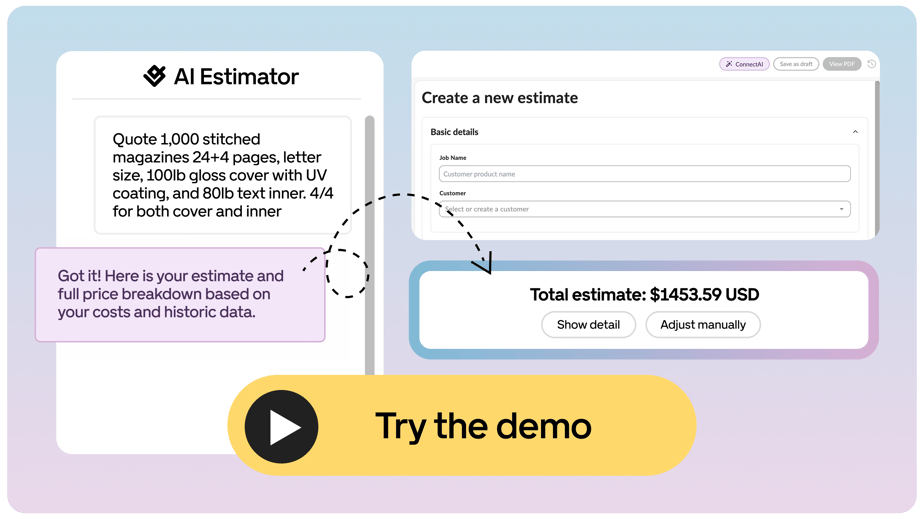
AI Estimators learn from historical production data and generate quotes in seconds. They know your actual production costs by analyzing what you've actually spent on similar jobs. They understand material waste based on your equipment and processes. They factor in labor cost, machine time, setup, and overhead automatically. The estimator doesn't have to think about it. The AI does.
The financial impact is significant. Estimators can quote 3 to 4 times more jobs in the same amount of time. Win rates improve by 2x or more because quotes are faster and more competitive. Quotes are also more accurate, which means fewer jobs that lose money or need reprints. For a shop with 50 jobs per week, this efficiency translates to thousands of dollars per month in improved margin.
Intelligent job scheduling and capacity optimization
Manual scheduling is a nightmare. Your production manager looks at a list of 50 jobs due in the next week and tries to figure out which press to run them on and in what order. They have to account for setup time, press-specific capabilities, team availability, and material. It's a giant optimization puzzle. They usually solve it by intuition and spreadsheet, which is suboptimal.
AI scheduling algorithms solve this automatically. They consider all constraints and variable, then propose an order that maximizes throughput, minimizes setup time, and meets deadlines. If a new rush job arrives, the algorithm reoptimizes instantly without disrupting the rest of the schedule. If a press breaks down, the system re-allocates jobs automatically.
The result is 25 percent or more throughput increase with the same equipment and team. Jobs move faster because setup time is minimized. Deadlines are met more consistently because the algorithm plans conservatively. Your team spends less time rescheduling and more time solving problems.
Predictive quality control
Quality problems usually discovered too late. A job finishes, it's packed, it ships, and then the customer complains about color drift or registration issues. By then you're scrambling to reprint, incurring material cost and labor, and damaging the customer relationship. Reprints are one of the biggest sources of waste in print operations.
Predictive AI systems monitor production data in real time and flag problems before they become waste. If color balance is drifting on a press, the system alerts the operator before the problem gets worse. If a substrate batch has a quality issue, the system flags it. If registration is off by a small amount that will compound over a run, the system recommends a calibration.
Bennett Graphics reduced their waste from 41 percent down to 10 percent through better data visibility and proactive problem solving. Predictive quality control was a key part of that improvement. When you catch problems early, you minimize waste and protect your margins.
Dynamic pricing based on demand and capacity
Most print shops use static pricing. You set prices once and stick with them. In reality, your optimal price changes based on what's in your queue. If you have excess capacity and a 30-day lead time, you could offer discounts. If you're at capacity with a 2-week lead time, you could charge premium prices. AI systems recommend prices dynamically based on current demand and available capacity.
This is already happening in other industries. Airlines price flights higher when flights are full and lower when they have empty seats. Hotels price room rates based on demand. Print shops can do the same. AI systems analyze your current job queue, predict demand based on historical patterns and customer behavior, and recommend prices that maximize revenue.
This doesn't mean nickle-and-diming customers. It means charging less when you have capacity and more when you don't. Customers are willing to pay more for fast delivery. When you're at capacity, charging more is fair to both parties. AI systems price optimally for the conditions you're in.
Workflow automation and integration
Beyond estimating and scheduling, AI enables broader workflow automation. Documents are generated automatically. Quality checks are automated. Data flows between systems without manual entry. Some platforms use AI to recommend which automation rules make sense in your specific workflow. Learn more about how cloud platforms deliver continuous automation improvement.
The compounding effect is powerful. When you automate estimating, you quote faster. When you automate scheduling, you get better capacity utilization. When you automate quality checks, you waste less. When you automate document generation and data flow, your team spends less time on administrative work. Together, these automations can increase throughput by 25 percent or more without any capital investment in new equipment. Procurement automation is another key workflow where AI and integration deliver substantial time savings.
Key takeaway
AI in print manufacturing isn't a distant future. It's available today and delivering measurable results. AI-powered estimating improves speed and accuracy. Intelligent scheduling increases throughput. Predictive quality control reduces waste. Dynamic pricing optimizes revenue. The print shops winning in 2026 are using AI as standard tooling, not as an experiment. If you're not using AI yet, you're leaving efficiency and profit on the table. The time to implement is now.
Ready to see AI in action? GelatoConnect includes an AI Estimator purpose-built for print. Learn about AI estimating for your print shop.