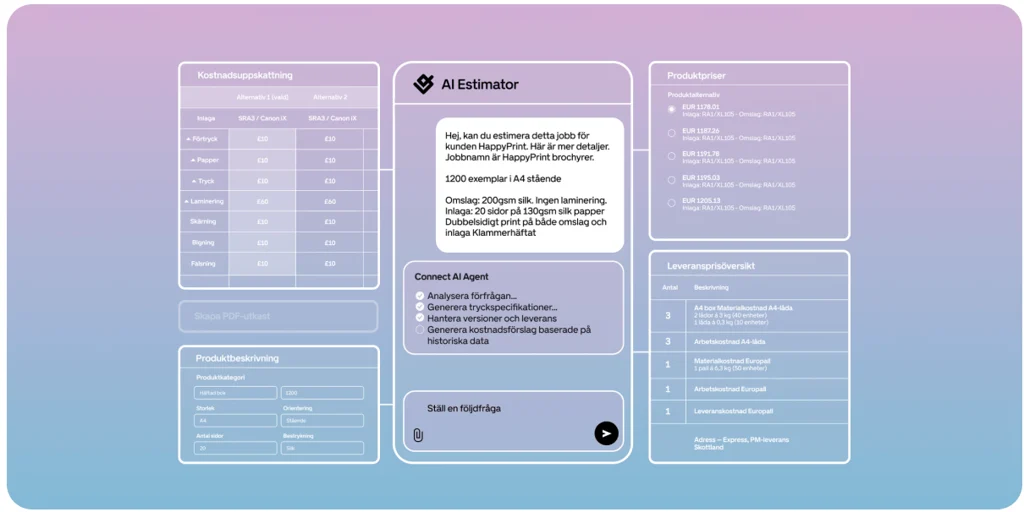
What is an automated quote generator?
An automated quote generator is software that calculates pricing for print jobs without manual estimation. Traditional systems use rule-based logic, applying fixed cost tables and markup formulas to standard job specifications. Predictive intelligence systems take a different approach, analyzing historical production data with machine learning to generate quotes based on actual cost patterns. While both eliminate manual calculations, predictive systems adapt to changing costs and complex job types automatically, delivering faster quotes with higher accuracy across diverse product catalogs.
How traditional automated quote generators work
Traditional automated quote generators apply rule-based logic to calculate prices. An administrator programs the system with cost tables, markup percentages, and formulas that map job specifications to a final number. When a request arrives, the system follows those rules step by step.
A rule-based system might calculate paper costs by multiplying sheet count by a fixed price per sheet, then add setup charges based on ink colors, and apply a finishing surcharge for each bindery operation. The logic is transparent and predictable.
This approach works for standardized products. If your operation primarily runs business cards, brochures, and basic booklets with consistent specifications, rule-based quoting delivers reliable results. The formulas reflect your actual costs, and the output is straightforward for your team to verify.
The limitations surface when jobs deviate from standard templates. Custom specifications, unusual substrates, complex finishing combinations, and variable run lengths introduce scenarios that fixed rules cannot price accurately. Administrators must continuously update cost tables and add exception logic. Over time, the accumulation of workarounds creates a fragile system that is expensive to maintain and prone to pricing errors on exactly the jobs where accuracy matters most.
What predictive intelligence brings to automated quoting
Predictive intelligence takes a fundamentally different approach to automated quote generation. Instead of applying fixed rules, it analyzes historical production data to learn the actual cost patterns behind completed jobs. The system identifies relationships between job specifications, materials, machine performance, and final costs that would be nearly impossible to capture in manual formulas.
As Andrew Ng has emphasized, the real power of machine learning lies in its ability to find patterns in operational data that humans cannot detect manually. GelatoConnect applies this principle specifically to print production through its AI Estimator, which evaluates each new quote request against thousands of past jobs with similar characteristics.
The predictive model factors in current material pricing, realistic machine run speeds based on your equipment's actual performance, waste rates for specific substrate and ink combinations, and seasonal cost fluctuations. The result is a quote grounded in real production outcomes rather than theoretical calculations. As the system processes more jobs, its accuracy improves continuously without requiring manual rule updates.
Performance comparison: rule-based vs. predictive automation
The differences between these two approaches show up clearly in operational metrics. Print businesses evaluating an automated quote generator should compare performance across five dimensions.
Traditional vs. predictive quote automation — performance benchmark 2026
|
Metric |
Traditional system |
Predictive intelligence |
Improvement |
|
Quote generation time |
30–45 minutes |
2 minutes |
95% reduction |
|
Accuracy on standard jobs |
90–95% |
98%+ |
3–8% improvement |
|
Accuracy on non-standard jobs |
70–85% |
95%+ |
10–25% improvement |
|
Manual rule updates required |
Weekly |
None (self-learning) |
100% reduction |
|
Daily quote capacity |
10–15 quotes |
100+ quotes |
7x capacity |
|
Error rate |
5–15% |
<2% |
Up to 90% reduction |
Source: GelatoConnect customer data, 2025–2026
The accuracy gap on non-standard jobs deserves attention. Traditional systems quote non-standard work by stretching existing rules or requiring manual overrides. This introduces inconsistency at exactly the point where margins are thinnest. Predictive systems handle variability natively because they learn from the full range of jobs your operation has completed, including the unusual ones. For businesses expanding into wide-format, apparel decoration, or specialty finishing, predictive quoting adapts without extensive reprogramming.
How each approach affects your margins
The margin impact of your automated quote generator choice compounds over time across three areas.
First, maintenance burden. Rule-based systems require ongoing manual updates whenever costs change, equipment is added, or new products are introduced. Someone on your team must maintain the formulas, test edge cases, and troubleshoot pricing errors. Predictive systems reduce this burden significantly because the model retrains itself as new production data flows in. Across the GelatoConnect platform, businesses achieve production error rates below 0.35%, a level of consistency that rule-based maintenance struggles to match.
Second, margin protection. Underquoting is the silent profit killer in print. Rule-based systems are particularly vulnerable when cost assumptions become outdated between manual updates. Predictive intelligence prices jobs based on current, real-world data, which means your margins reflect actual production costs rather than assumptions that may be weeks or months old.
Third, speed to revenue. Both approaches generate quotes faster than manual estimating. However, predictive systems typically require less human review because their outputs already account for production nuances that would trigger manual adjustments in a rule-based system. Fewer quotes stuck in an approval queue means faster customer responses and higher close rates.
When each approach makes sense
Traditional rule-based quoting remains a reasonable choice for operations with a narrow, standardized product catalog and stable cost structures. If your shop runs the same core products month after month with minimal variation, the simplicity of fixed rules may serve you well.
Predictive intelligence becomes the stronger option as complexity grows. Print businesses offering diverse product lines, handling variable run lengths, sourcing from multiple vendors, or expanding into new categories benefit most from a system that adapts to complexity rather than requiring you to manually account for every scenario. According to Forrester research on B2B sales automation, businesses that adopt AI-powered pricing tools see measurable improvements in both quote accuracy and sales cycle velocity.
The trend in the industry is clear. ESP, a commercial printing business, freed up $300,000 in capital by implementing GelatoConnect's AI-powered procurement and estimating. That capital had previously been locked in manual processes, excess inventory, and pricing inefficiencies that rule-based systems could not resolve. Oschatz achieved 20% growth without adding staff, in part because their automated quoting scaled with demand rather than requiring additional headcount to maintain.
Evaluating your next automated quote generator
The right choice depends on your operation's trajectory. Consider the complexity of your product mix, the pace at which your costs change, and how much time your team currently spends maintaining and correcting quotes. If those factors point toward growing complexity and thinning margins, predictive intelligence offers a measurable advantage.
Start by auditing your current quoting process. Measure how long quotes take, how often they require manual adjustment, and what your win rate looks like on non-standard jobs. Those numbers will reveal whether your current system is keeping pace or holding you back.
Ready to see how predictive quoting compares to your current automated quote generator? Explore the GelatoConnect AI Estimator and discover how production intelligence can sharpen your quotes and protect your margins.
People also ask (PAA)
|
Question |
Answer |
|
How does an automated quote generator work in print production? |
An automated quote generator calculates print job pricing by applying either fixed rules or predictive algorithms to job specifications. Rule-based systems use programmed cost tables and markup formulas. Predictive systems analyze historical production data to identify actual cost patterns, factoring in material prices, machine performance, waste rates, and current capacity. |
|
Can traditional quote generators compete with AI pricing systems? |
Traditional rule-based generators perform well for standardized products with stable costs. They struggle with non-standard jobs, complex finishing, and rapidly changing material prices. AI pricing systems handle variability natively and improve accuracy over time. For operations with growing product complexity, predictive systems deliver measurably better results. |
|
When should a print business switch from rule-based to predictive quoting? |
Consider switching when your team spends significant time maintaining pricing rules, when non-standard jobs represent a growing share of your work, or when margin erosion suggests your cost assumptions are outdated. Businesses processing 50 or more quotes per week typically see the fastest ROI from predictive quoting. |
|
What is the difference between automated quoting and intelligent quoting? |
Automated quoting applies pre-programmed rules to generate prices quickly. Intelligent quoting uses machine learning to analyze production history and generate prices based on actual cost patterns. The key difference is adaptability: automated systems require manual updates while intelligent systems learn and improve continuously from your production data. |
|
How accurate are AI-based print quote generators? |
AI-based quote generators using predictive intelligence achieve 98%+ accuracy on standard jobs and 95%+ on non-standard work, based on GelatoConnect platform data. Traditional rule-based systems typically achieve 90–95% on standard jobs but drop to 70–85% on non-standard work. The accuracy gap widens as product complexity increases. |